Phone Numbers vs. Platform UIDs: A Guide to Accurate Contact Verification
Learn the key differences between phone numbers and platform UIDs to prevent CRM matching errors and improve contact list verification workflows.
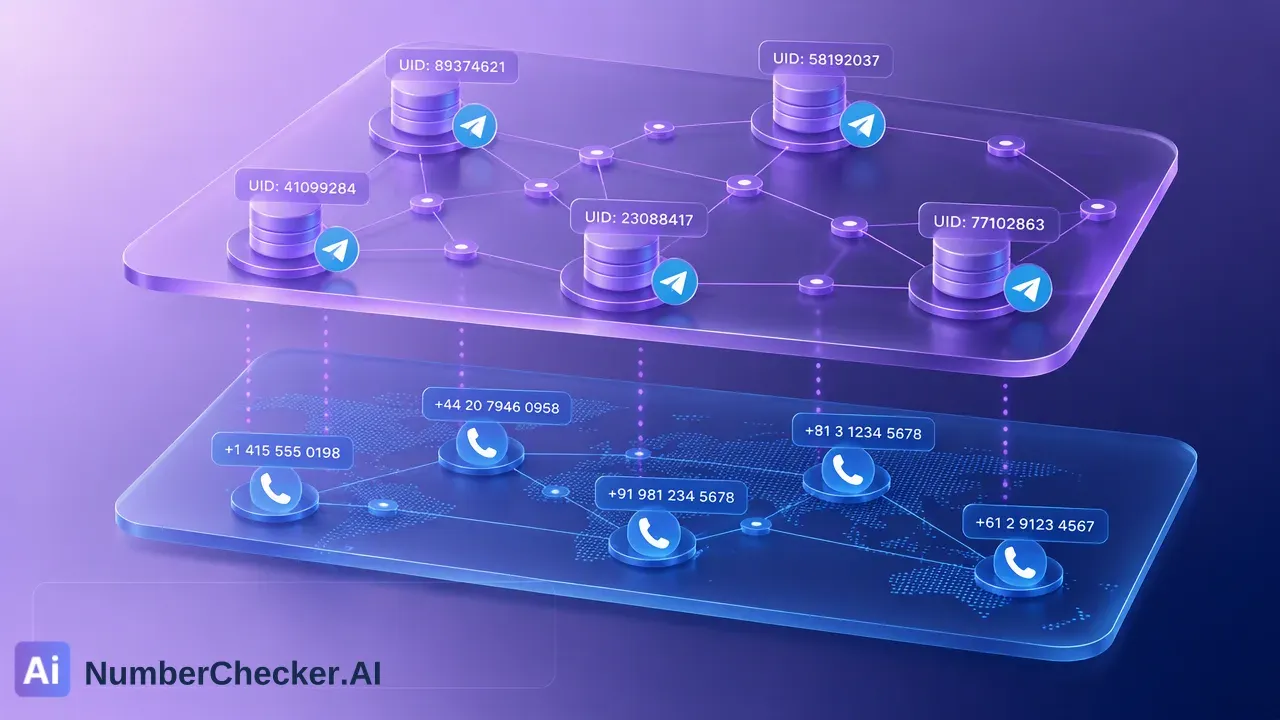
Phone numbers and platform-specific user identifiers (UIDs) serve different functions within customer data architecture. A phone number is a network-level telecommunications identifier tied to carrier routing and SIM hardware, whereas a platform UID is an internal digital record assigned by an individual application. Because these identifiers exist in isolated technical domains, teams cannot mathematically derive a UID from a phone number or calculate a phone number from an existing UID. Accurate contact list management requires treating these data points as separate attributes within databases, verifying reachability on each specific channel, and linking records only when an authenticated relationship connects them.
Understanding the Identifier Gap
Customer databases frequently ingest contact points across multiple touchpoints, including SMS sign-up forms, eCommerce purchase records, support chat interactions, and direct messaging channels. A common operational mistake is treating telecommunication contact points and application-level profiles as interchangeable values. A phone number represents a telecommunications network identifier. Its structure follows standardized geographic and carrier routing protocols designed to direct voice and SMS traffic across public switched networks. In contrast, a platform UID is a proprietary digital identifier generated within an application’s database schema. The platform utilizes this internal key to track account permissions, relational data, and user activity. | Attribute | Phone Number | Platform UID | | :--- | :--- | :--- | | Layer | Telecommunications network | Application database | | Standardization | Standard international routing | Proprietary application format | | Derivation | Standalone global address | Platform-generated internal key | | Verification Scope | Carrier and platform presence | Application-specific record lookup | Because these identifiers reside in distinct systems, organizations cannot derive one from the other. A phone number cannot be hashed, decoded, or algorithmically translated into a Facebook UID, a Telegram UID, or any other proprietary identifier. Validating presence across communication channels requires querying channel-specific registration signals rather than assuming cross-network continuity.
The Impact of Privacy and Platform Architecture
Beyond mathematical separation, application architecture and user privacy settings create distinct boundaries between network identities and platform entities. Many communication platforms allow users to separate their phone number from their public-facing presence. Modern platforms frequently provide account-level privacy controls that govern whether a phone number can be used for search and discovery. An individual may register an account using a mobile number while configuring application permissions to block contact matching by third parties. In these scenarios, querying an identifier may indicate that an account exists without exposing public metadata or account UIDs. Furthermore, account-presence signals represent a specific moment in time. Organizations must recognize that visibility limitations are standard architectural design choices by platform developers to safeguard consumer data.
Best Practices for CRM Data Integrity
Maintaining data integrity across complex enterprise stacks requires strict relational schema design. When data teams merge unverified records, CRM hygiene degrades rapidly, creating split customer journeys and broken communication cadences. To preserve contact list accuracy, organizations should implement the following architectural practices:
- Preserve Isolated Channel Columns: Store phone numbers, email addresses, and platform-specific UIDs in distinct database fields. Never overwrite a customer’s primary telephone field with an application handle or internal platform key. - Avoid Unauthenticated Data Merging: Avoid merging disparate data sources, such as eCommerce order logs and social media engagement histories, based purely on speculative matches or matching first names. Require an authenticated login, verified link, or direct user confirmation before joining customer tables. - Maintain Channel-Specific Verification Timestamps: Record validation dates separately for each channel. - Standardize Formats Before Signal Evaluation: Clean incoming numbers using consistent international formats prior to running bulk verification checks, ensuring downstream verification tools process uniform datasets.
Maintaining Reachability in Bulk Workflows
Operational efficiency in customer outreach depends on validating channel availability before launching communication campaigns. Contact lists naturally decay over time as numbers are disconnected, reassigned, or deactivated across messaging networks. Pre-campaign hygiene helps teams review contact lists and prioritize resources effectively. NumberChecker.AI supports high-volume list maintenance by providing bulk phone-number and email list checking services. Teams upload contact lists via CSV or TXT files or connect programmatically through REST API access to assess list readiness before sending high-volume messages. Bulk checks identify valid entries across supported platforms, such as Telegram account presence or Gmail and Yandex email status, helping teams clean contact lists and focus outreach on reachable endpoints. By checking bulk lists systematically, data operations teams establish clear channel segmentation. They determine which records support standard SMS communication, which contacts maintain accounts on specific messaging channels like Telegram, and which addresses possess active email mailboxes. This layered approach ensures contact records remain clean, organized, and operationally reliable across every business channel.
Frequently Asked Questions (FAQ)
Can teams convert a phone number directly into a platform UID?
Direct algorithmic conversion between a phone number and a platform UID is technically impossible. Phone numbers follow international telecommunication conventions, while UIDs are arbitrary numerical strings or hash values generated by private application databases. Determining whether an account exists requires evaluating platform-specific registration signals at check time rather than parsing or translating the phone string.
Why do CRMs show mismatched data when blending contact channels?
Data mismatches occur when CRMs merge records across channels without a verified foreign key. For example, assuming an eCommerce checkout phone number belongs to the same individual as a social media account using a similar username creates corrupted profiles. Separate interaction contexts require independent validation before database fields are unified.
How do platform privacy settings affect identifier visibility?
Application privacy configurations determine whether platform-level identifiers and account attributes are visible publicly. Even when an active account is registered with a phone number, account holders can restrict profile exposure, phone discoverability, and public UID indexing within application permission controls.
Get Started with NumberChecker.AI
Explore NumberChecker.AI’s supported bulk list-checking products and choose the capability that fits your workflow.
Ready to get started?
Try our WhatsApp number validation service and see the difference clean data makes.

