How to Identify and Filter High-Risk WhatsApp Contacts to Protect Your Sender Reputation
Learn WhatsApp contact list risk management strategies to filter high-risk numbers, evaluate reachability signals, and support sender reputation.
WhatsApp contact list risk management requires more than confirming whether a phone number exists on the platform. While basic checks show platform registration at check time, maintaining sender reputation requires evaluating contact origin, verifying explicit consent, and filtering out recipients likely to block or report incoming messages. Combining bulk registration verification with activity signals and disciplined list hygiene helps teams prioritize responsive audiences, pause outreach to ambiguous records, and mitigate the risk of messaging restrictions.
The Link Between List Hygiene and Sender Reputation
High-volume business messaging relies heavily on domain and account standing. On WhatsApp, user feedback mechanisms—specifically blocking and spam reporting—serve as primary inputs for platform enforcement actions. When recipients receive unsolicited communications, their immediate recourse is to report the sender. Accumulating reports within a narrow window signals disruptive messaging behavior, which can trigger automated restrictions or outright account bans. Maintaining account health requires proactive list screening before launching outreach. If a contact list contains stale records, unverified numbers, or recipients with no prior relationship to the business, the likelihood of defensive user action escalates.
Distinguishing Between Active Numbers and Safe Outreach Contacts
A common operational misconception is equating an active phone number with a safe recipient. Phone verification encompasses several distinct layers of analysis:
| Verification Layer | Data Provided | Operational Meaning |
|---|---|---|
| Format & Normalization | Structural compliance with E.164 standards | Confirms number structure is syntactically valid |
| Platform Registration Signal | Account presence on WhatsApp at check time | Confirms the line can receive platform messages |
| Activity Context | Last-seen indicators and business profile context | Indicates recency of presence to support tiering |
| Safety & Consent Status | Documented opt-in and contact source history | Informs likelihood of user acceptance versus reporting |
| A standard platform registration check confirms that an account exists at verification time, but it does not confirm user intent, active daily engagement, or consent. Outreach to registered numbers that lack clear opt-in documentation remains a primary driver of user complaints. |
Contact Source Transparency and Strategic Risk Assessment
Evaluating risk requires assessing the origin of every contact record. Lists compiled through inbound inquiries, authenticated sign-ups, and clear opt-in checkpoints demonstrate high source transparency. Recipients in these segments expect communication, which substantially lowers report rates. Conversely, third-party databases, shared contact sheets, or legacy cold records lack verified consent trails. Treating all records uniformly creates vulnerability. High-risk indicators—such as unconfirmed opt-in status, prolonged inactivity, or ambiguous sourcing—do not represent a permanent blacklist. Instead, they serve as an operational signal to adjust communication strategy. Teams can route unverified contacts to secondary confirmation channels, pause bulk outreach, or request re-opt-in rather than initiating high-volume messaging.
Implementing a Proactive Bulk Filtering Workflow
To manage large databases efficiently, teams integrate bulk checking workflows that clean lists before CRM ingestion or campaign execution. NumberChecker.AI provides bulk list checking via CSV or TXT uploads alongside REST API access for automated pipelines. A structured screening workflow includes three core phases:
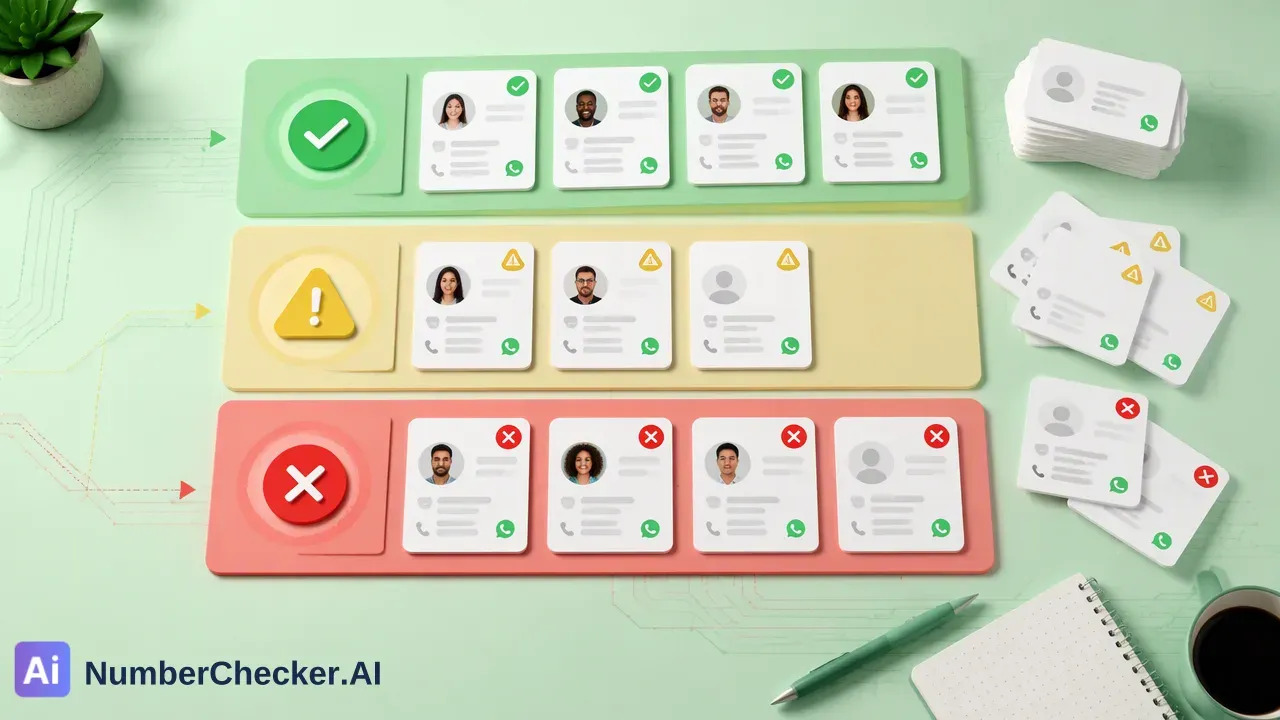
- Bulk Ingestion and Registration Verification: Run lists through tools like WhatsApp Number Checker or WhatsApp Advanced Checker to verify account presence on the platform, filtering out unregistered records immediately. 2. Contextual Enrichment: Use WhatsApp Days Checker to gather available activity, last-seen, and business-account signals, allowing teams to isolate dormant numbers from recently observed accounts. 3. Risk Tiering and Policy Application: Segment contacts into actionable tiers. Active, verified opt-in records proceed to standard messaging workflows. Inactive, unverified, or high-uncertainty contacts are flagged for consent re-verification or paused entirely.
Avoiding the Operational Trap of Retry Loops
When messages fail or accounts encounter user resistance, some teams attempt aggressive re-sending or switch to new sending channels to reach the same unverified audience. This practice, known as a retry loop, compounds operational risk. Repeatedly attempting to contact users who have ignored, blocked, or reported previous outreach accelerates platform penalties. Modern messaging networks monitor collective behavior across channels; rotating senders while maintaining identical low-quality lists results in rapid bans on newly provisioned accounts. Instead of cycling through accounts, organizations should treat non-responsiveness and delivery failures as signals to prune the database. Regular automated list verification and consent audits establish sustainable messaging operations without exposing infrastructure to avoidable enforcement actions.
Frequently Asked Questions (FAQ)
How does platform registration status affect sender reputation?
A platform registration signal confirms that a phone number is registered with WhatsApp at the time of verification. Sending messages to unregistered numbers wastes resources and generates delivery failures. If an organization messages registered recipients who did not opt in, those users may block or report the sender, which directly damages account reputation.
Can bulk verification identify inactive WhatsApp accounts?
Bulk verification tools such as WhatsApp Days Checker provide available activity and last-seen context alongside account presence. This information helps teams distinguish between accounts with recent platform interaction and dormant profiles, supporting smarter audience prioritization before message dispatch.
Why is contact source transparency critical before sending campaigns?
Contact source transparency establishes how an entry entered the database. Inbound contacts who voluntarily submitted their details and opted in carry lower reporting risks. In contrast, purchased or scraped cold lists carry elevated risks of user spam reports, regardless of whether the numbers are technically active.
Get Started with NumberChecker.AI
Explore NumberChecker.AI’s supported bulk list-checking products and choose the capability that fits your workflow.
Ready to get started?
Try our WhatsApp number validation service and see the difference clean data makes.

