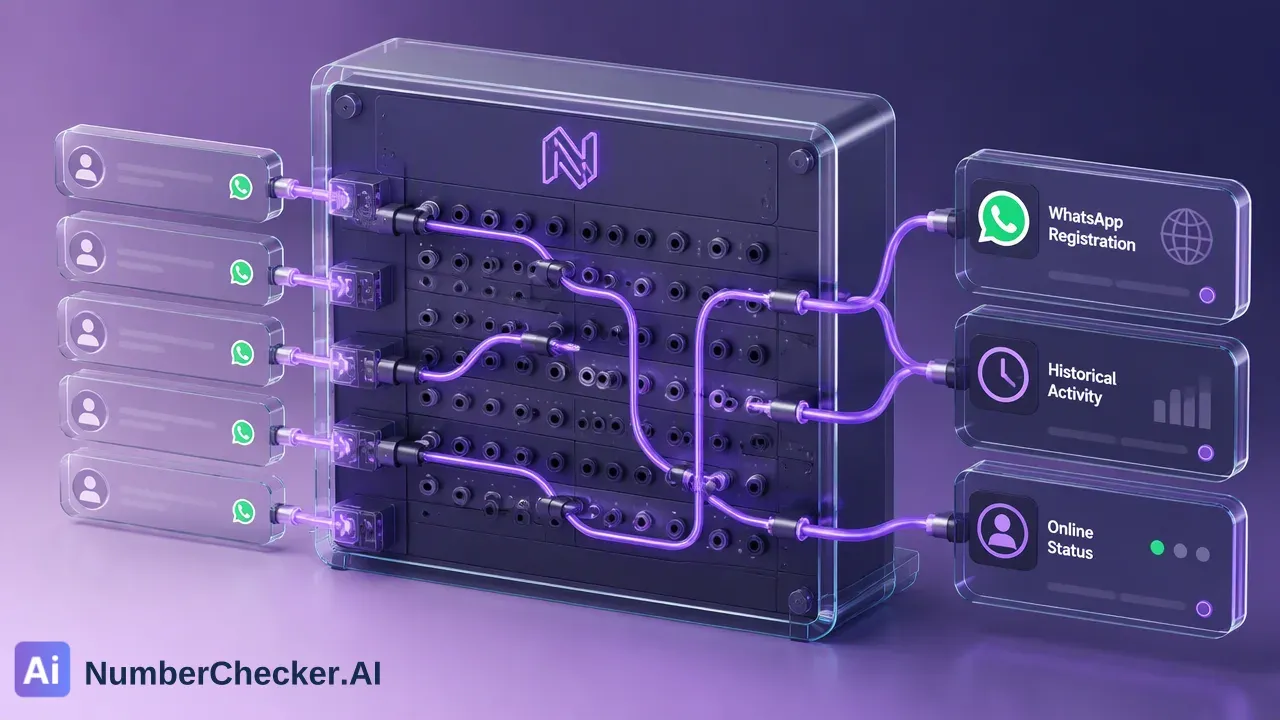
WhatsApp Contact Prioritization: Online Status vs. Activity Signals
Learn how to use WhatsApp registration, activity signals, and online status to prioritize contact lists effectively for business outreach.
WhatsApp contact prioritization requires distinguishing between account existence, recent activity context, and transient online status. A platform registration check confirms whether a phone number is associated with an active account at check time, serving as the baseline for list hygiene. In contrast, activity signals offer historical presence context suitable for segmenting re-engagement campaigns. Fleeting online status should be restricted to time-sensitive interactions within established conversations rather than cold contact prioritization.
Understanding the Hierarchy of WhatsApp Signals
Establishing an effective messaging strategy requires categorizing platform data into functional layers. Teams managing large-scale communications frequently handle multiple data points, but confusing momentary indicators with persistent account traits leads to inefficient routing. * Registration Signal: A platform-level confirmation verifying that a phone number is associated with a WhatsApp account at the time of the check. It defines basic reachability. * Activity Signal: Contextual metadata indicating recent account presence or last-seen activity, offering visibility into whether an account has been used recently. * Online Status: A transient, instantaneous indicator reflecting that a user has the application open at that specific moment. Treating these signals as distinct operational tiers allows teams to design logical screening workflows rather than treating any single signal as a proxy for lead intent.
The Role of Registration Status in List Hygiene
Platform registration screening serves as the initial filtering step for bulk list maintenance. Using tools like the WhatsApp Number Checker, organizations can screen databases to confirm whether records exist on the network before scheduling communications. However, a positive registration signal indicates only reachability and platform presence at the check timestamp. Teams should use registration screening to filter out unregistered numbers, preventing wasted routing overhead while avoiding the assumption that account existence equates to audience engagement.
Leveraging Activity Signals for Re-engagement
When planning re-engagement campaigns or prioritizing older database segments, standard registration screening may leave ambiguity regarding which contacts are periodically active. This is where activity context becomes useful. Tools such as the WhatsApp Days Checker provide available activity or last-seen context alongside business profile signals. Unlike instantaneous status, activity context reflects whether an account has documented platform presence over recent intervals. This distinction helps teams direct re-engagement campaigns toward contacts with verified recent presence, improving operational efficiency over static list broadcasting.
Strategic Limitations of Online Status
Monitoring momentary online status is common in live customer support environments, but using it as a trigger for cold or early-stage marketing outreach carries notable operational drawbacks. Because online status is ephemeral, attempting to trigger automated messaging the moment an unfamiliar contact appears online often produces a disruptive user experience. Recipients frequently perceive unsolicited messages sent during active browsing sessions as intrusive, which can prompt them to block the sender or report the conversation. Consequently, real-time status is appropriate primarily for established, two-way conversational support rather than bulk outreach filtering.
Building a Balanced Contact Management Workflow
A sustainable contact management architecture incorporates platform signals alongside internal records and recipient channel history. Relying solely on messaging indicators can misalign outreach with user preferences. | Signal Type | Primary Utility | Typical Application | | :--- | :--- | :--- | | Registration Check | Baseline reachability | Bulk list hygiene and filtering non-existent accounts | | Activity Context | Longitudinal reachability | Prioritizing dormant lists for re-engagement | | Online Status | Immediate availability | Managing inbound, agent-led customer service | Organizations should execute list hygiene via CSV or TXT uploads or REST API endpoints supported by bulk verification services, ensuring databases are continuously sanitized. Combining bulk registration verification with historical channel responsiveness—such as past email or messaging interactions—ensures contact workflows remain balanced and respectful of customer communication habits.
Frequently Asked Questions (FAQ)
How does WhatsApp registration status differ from active platform usage?
WhatsApp registration status functions strictly as a check-time presence check confirming that an account exists for a specific phone number. It does not measure user activity frequency, account engagement, or user intent.
Why should organizations avoid using online status for cold outreach?
Online status is a temporary, transient indicator. Attempting to trigger cold outreach based on real-time presence can feel intrusive to recipients, potentially leading to elevated user block rates and negative sentiment.
How do activity signals support contact re-engagement workflows?
Activity signals provide historical context, such as last-seen data, helping teams identify which records have recent platform presence. This allows organizations to prioritize reachable segments without relying on momentary presence.
Get Started with NumberChecker.AI
Explore NumberChecker.AI’s supported bulk list-checking products and choose the capability that fits your workflow.
Ready to get started?
Try our WhatsApp number validation service and see the difference clean data makes.

