How to Build a Scalable WhatsApp Verification Workflow for Bulk Outreach
Learn how to build a scalable WhatsApp bulk verification workflow using CSV uploads and REST API integration to improve list hygiene and support outreach.
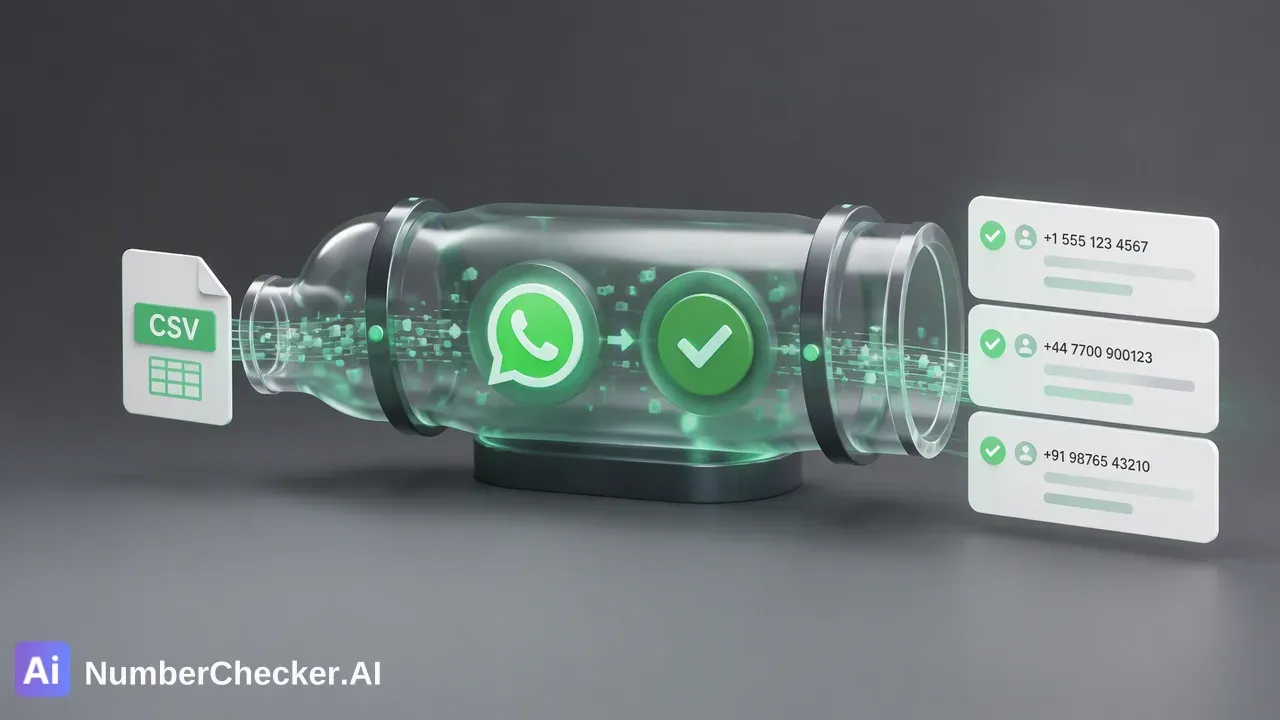
Building a scalable WhatsApp bulk verification workflow requires integrating bulk list cleaning as a mandatory pre-send step in your messaging pipeline. By using bulk CSV uploads or REST API integrations to check account presence, teams can filter out unreachable numbers before initiating contact. This process helps reduce wasted outreach budget and supports sender reputation management by minimizing messages sent to invalid accounts. Furthermore, combining baseline registration checks with available activity signals and profile context provides a decision-support framework that helps teams segment audiences and prioritize outreach more effectively.
The Strategic Importance of WhatsApp List Hygiene
Messaging pipelines rely on accurate contact data to function efficiently. When teams initiate bulk outreach without first confirming account presence, they risk sending messages to phone numbers that are not registered on the platform. Directly messaging invalid numbers wastes outreach budget and can trigger platform spam filters, which negatively impacts sender reputation. A scalable WhatsApp bulk verification workflow addresses this by introducing a list hygiene stage before any messages are sent. By confirming which numbers are actually registered on the platform, organizations can refine their contact lists. This pre-send filtering supports better resource allocation, ensuring that messaging infrastructure is dedicated only to reachable accounts. Maintaining high list hygiene is a foundational practice for any team managing large-scale communications, as it directly informs internal decisions about which contacts to prioritize and which to remove from active campaigns.
Choosing Your Verification Method: Manual vs. Automated
Organizations can approach bulk list cleaning through different methods depending on their technical resources and operational scale. The core workflow for a WhatsApp bulk verification workflow involves processing supported phone-number lists, which can be executed manually or programmatically. For manual tasks or smaller, ad-hoc campaigns, bulk workflows support CSV or TXT list uploads. Teams can export a contact list from their database, upload the file for processing, and retrieve the results to update their records. This method requires no coding and is suitable for periodic list hygiene exercises. For continuous, high-volume operations, REST API access allows for automated list validation directly from customer relationship management (CRM) systems or data pipelines. Integrating a RESTful API enables teams to programmatically submit phone numbers for verification and retrieve the resulting signals without manual intervention. The API has rate limits that restrict requests per minute and limits on concurrency, so teams should consult the current API documentation for applicable limits to ensure smooth integration alongside existing marketing stacks.
Beyond Registration: Leveraging Activity Signals
While confirming basic platform registration is the critical first step in a WhatsApp bulk verification workflow, relying solely on a binary registered-or-not status leaves valuable context on the table. Registration status serves as the baseline, but additional data points can further inform outreach strategies. The WhatsApp Days Checker provides capabilities beyond the standard platform registration signal. When checking account presence, it can also provide available activity or last-seen context, alongside available business-account and profile enrichment. These activity signals offer deeper insights into how a phone number interacts with the platform. For example, knowing whether an account has recent activity context helps teams segment their audiences more precisely. Rather than treating all registered numbers equally, organizations can use these enrichment signals as a decision-support tool for lead prioritization. This layered approach—combining baseline registration with activity and profile context—supports more nuanced internal decisions regarding campaign routing and audience segmentation.
Implementing a Scalable Pipeline
Integrating a WhatsApp bulk verification workflow into an existing system requires positioning the check at the correct stage of the data lifecycle. Verification should be a mandatory pre-send step in every messaging pipeline, occurring after data collection but before campaign execution. A standard implementation begins with extracting the target phone numbers from the central database or CRM. In an automated pipeline, the system uses API jobs to submit these numbers for bulk checking. The pipeline then monitors the task status and retrieves the results programmatically once the verification process is complete. Upon receiving the data, the system routes the contacts based on the returned signals. Numbers lacking a platform registration signal are flagged or removed from the active campaign list, while registered numbers are passed forward to the messaging engine. If activity or profile enrichment signals are available, the pipeline can further sort the remaining contacts into prioritized tiers. By structuring the workflow in this manner, organizations establish a systematic, repeatable process that continuously supports list hygiene and informs outreach prioritization without requiring constant manual oversight.
Frequently Asked Questions (FAQ)
Why should I verify WhatsApp numbers before a campaign?
Verifying WhatsApp registration status before initiating a campaign is a critical list hygiene practice. Directly messaging invalid or unregistered numbers wastes outreach budget and can trigger platform spam filters, which harms your sender reputation. By implementing a pre-send verification step, you can filter out unreachable numbers, support your messaging infrastructure, and ensure your resources are focused on accounts with confirmed platform presence.
What is the difference between a manual bulk upload and an API integration?
The primary difference lies in how the data is submitted and processed. Manual bulk workflows support CSV or TXT list uploads, allowing teams to export lists, upload them for checking, and manually update their records. This is ideal for periodic tasks. In contrast, a REST API integration allows for automated list validation directly from a CRM or data pipeline. The API method supports programmatic submission and result retrieval, making it the preferred choice for continuous, scalable workflows.
Get Started with NumberChecker.AI
Explore NumberChecker.AI’s supported bulk list-checking products and choose the capability that fits your workflow.
Ready to get started?
Try our WhatsApp number validation service and see the difference clean data makes.

