TikTok Phone Check Results: Registration, Username, and UID
Learn how to interpret TikTok phone check results and retain registration, optional username and UID without claiming identity or consent.
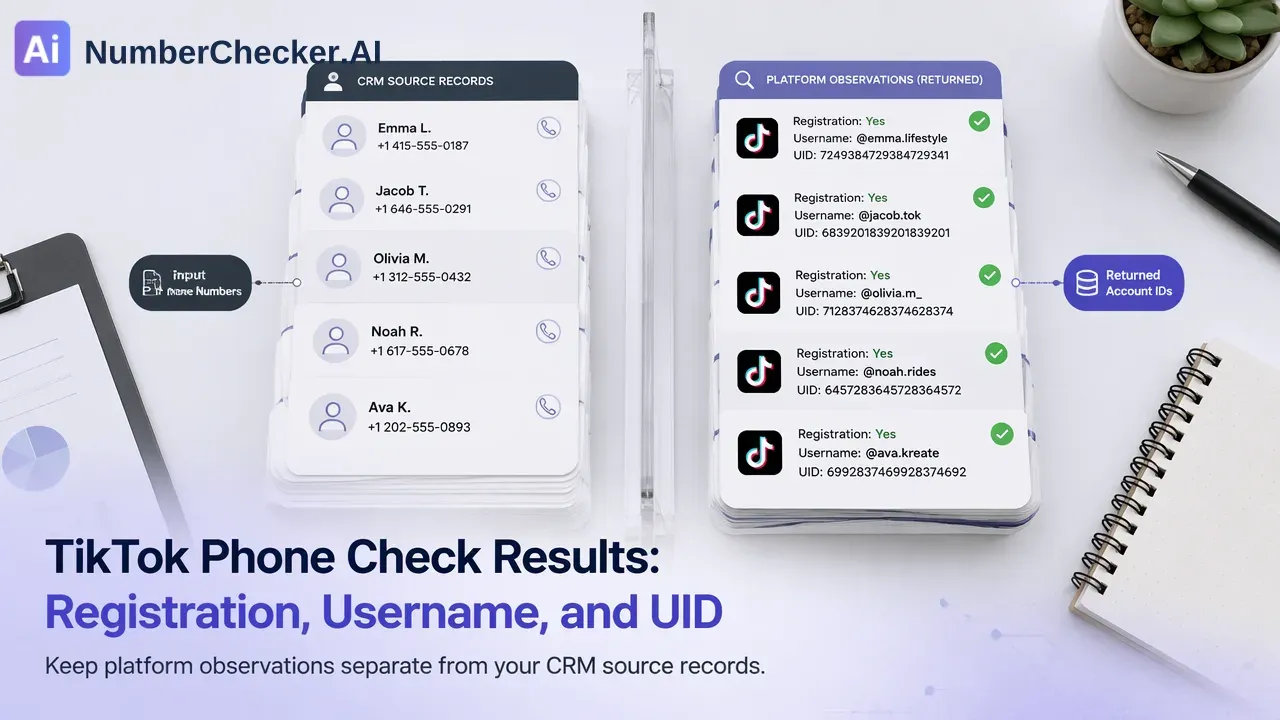
Treat the submitted phone number as the input, registration as an observation at check time, and any returned username or UID as optional account identifiers. Keep those fields separate in your CRM; none proves who owns the phone or authorizes contact.
Start with the question the check actually answers
A CRM team may already hold a permitted list of phone numbers and need to reconcile a TikTok Checker export with its source records. The check begins with those numbers. Its registration result concerns whether a submitted number is observed as registered with TikTok at the time of the check. It is a platform-specific signal, not a general statement that the number is valid, reachable, controlled by the person named in the CRM, or available for outreach.
The product page describes a bulk CSV or TXT workflow and identifies number, activated, username, and uid among the outputs a customer can review. The page also says available username and UID signals may be returned. It does not establish that both identifiers appear on every registered row, and a team should not build a rule that assumes they do. Nor should it infer a precise response schema, error code, or account-history guarantee from these high-level descriptions.
For reconciliation, ask one narrow question first: what did the check observe for this submitted number? Preserve the original source record and the returned observation separately. If the result says registered, record a positive TikTok registration observation. If it says not registered, record that check-time result without turning it into a permanent statement about the number or a person.
Read username and UID as different kinds of context
A phone number is the identifier you submitted. A username is an account-facing handle when one is available. A UID is an account identifier when returned. Neither is a substitute for the input number, and neither should overwrite the source number in your CRM. The product page names both fields, but does not promise that either is a verified identity field.
Handles can change, so a saved username should be treated as a dated observation rather than a permanent contact key. TikTok’s username help page describes changing a username and the effect on a profile link. A UID can help distinguish an account reference from a changeable display handle, but the mere presence of a UID in a result still does not establish the identity of the person behind the account or a durable phone-to-person relationship. Keep identifiers as text so systems do not alter long digit strings by numeric conversion.
This is also why a username-to-UID guide answers a different question. Those tools start with a known handle or profile and seek an account identifier. Here, the starting point is a supplied phone list and the first question is registration for each submitted number. A profile search result cannot fill a missing identifier in the checker export, and it cannot independently verify the relationship between your source row and a named CRM contact.
Keep absent identifiers separate from a negative result
Suppose a row reports TikTok registration but no usable username or UID. Retain the registration observation and mark the identifier as unavailable or not returned in your own processing. Do not rewrite that row as “not registered,” invent a handle, or borrow an identifier from a similarly named profile. The product’s “available” wording leaves room for rows without those fields; it does not explain every reason an identifier might be absent.
Use separate statuses in downstream review: registration observed, registration not observed, and unresolved or unprocessed if your actual export or task documentation supports such a distinction. For optional identifiers, use present versus absent or unavailable. This avoids turning a blank username cell into an account verdict. If a business decision depends on an identifier, route the row for a documented follow-up review instead of silently filling it.
The same discipline applies when a previously stored handle differs from a fresh one. Preserve both observations with their dates. A changed handle is one possible explanation, but the checker output alone is insufficient to assert that an account changed names or that two records refer to the same human. Verify any proposed merge against evidence your organization is entitled to use.
Build a result row your CRM can audit
A practical internal record separates source data from checker output. The following is a suggested CRM design, not a claim about the exact columns in a downloadable NumberChecker file.
| CRM field | Meaning to retain | What not to infer |
|---|---|---|
| Source record ID and submitted phone | The list row and number sent for checking | A named person’s current ownership |
| Check timestamp and product | When the TikTok-specific observation was obtained | Permanent account status |
| Registration observation | The returned platform result for that input | General validity or permission to contact |
| Username, if available | A handle observed with this result | A fixed handle or verified legal name |
| UID, if available | A returned account identifier | Consent, account control or identity |
Keep the raw export and a mapping to the original source row so an analyst can trace decisions back to what was actually submitted. Record check time in your own job metadata if the export itself does not include a usable timestamp; do not pretend it is a field guaranteed by the product. Preserve empty optional fields as empty, alongside a clear availability status. If you repeat checks, append a new dated observation rather than replacing the previous one without a history.
For example, imagine a source row labeled C-104 with a supplied number. A result reports registration and a username but no UID. The CRM should retain C-104, the original number, the check time, the registration observation and the returned username; the UID remains unavailable. It should not auto-populate “TikTok owner = C-104 contact,” because the check did not establish that relationship. This example is illustrative, not a real customer result.
Use the observation for review, then decide separately on contact
A result can help a team segment records for further review, but registration and account identifiers do not supply a lawful basis, prior express and informed consent, or a guarantee that a message will reach anyone. Keep permission and channel preference in separate CRM fields governed by your own evidence. A positive registration signal should never silently activate an outreach workflow.
If your goal is to reconcile an existing phone list, review the current TikTok Checker product page, run the supported bulk workflow on numbers your organization may process, and compare each returned observation with its source row. Define the registration and identifier columns before import so missing values remain visible. Then let a person or an approved rule decide whether further verification is warranted. The result is a clearer list, not proof of a person.
Get Started with NumberChecker.AI
Explore NumberChecker.AI’s supported bulk list-checking products and choose the capability that fits your workflow.
Ready to get started?
Try our WhatsApp number validation service and see the difference clean data makes.

