Phone Verification Best Practices: A Guide to Bulk Data Hygiene
Learn phone verification best practices for bulk data hygiene. Discover how carrier intelligence and registration signals support clean contact lists.
Effective phone verification best practices rely on a tiered workflow: starting with basic format validation, followed by bulk processing for carrier intelligence and registration signals. By integrating bulk workflows via CSV uploads, TXT files, or REST API access, businesses can maintain clean contact lists and gain actionable insights into line types and regional context without manual intervention. The core workflow is bulk checking of supported phone-number or email lists, which helps teams review data accuracy and supports ongoing data hygiene initiatives. Rather than relying on single-number lookups, organizations can process large datasets efficiently to inform internal decisions about contact management.
The Importance of Bulk Verification Workflows
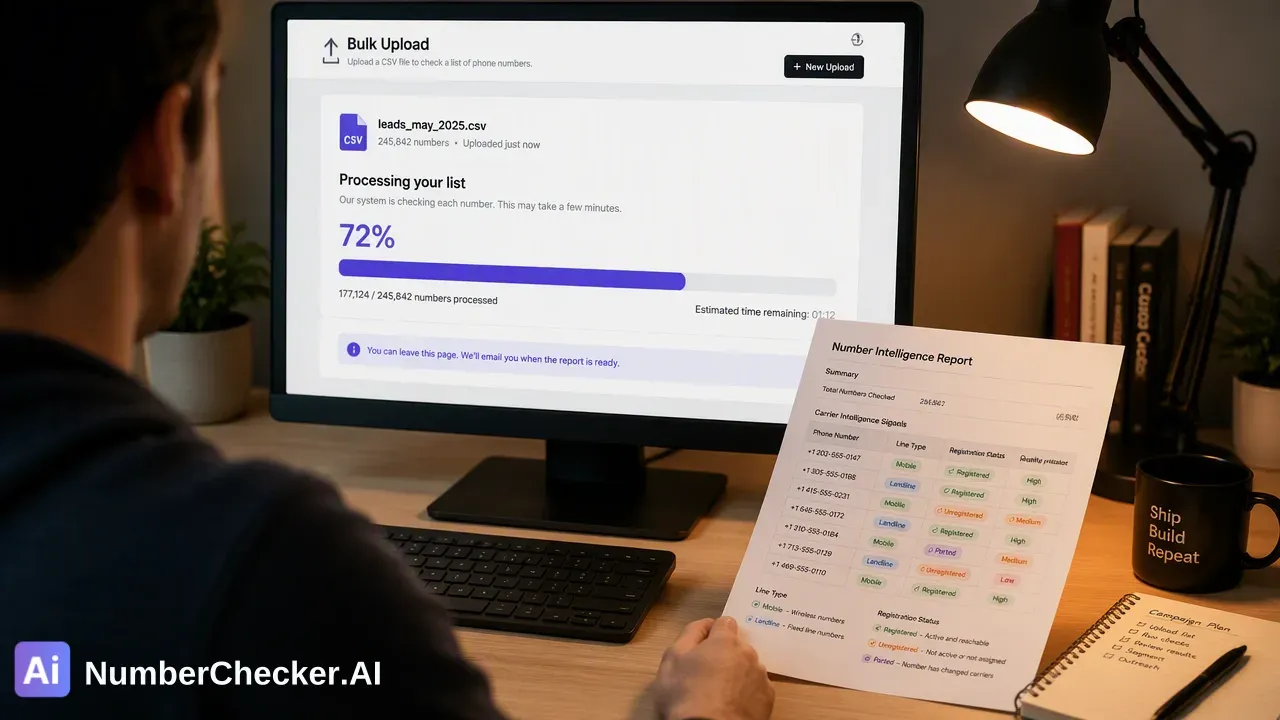
Managing large-scale contact data requires efficient processing methods rather than manual, one-by-one checks. The core workflow for maintaining data hygiene is the bulk checking of supported phone-number or email lists. Bulk verification workflows support CSV or TXT list uploads and REST API access, providing flexible integration options for technical and business teams. Implementing bulk processing as a foundational step helps organizations handle extensive datasets systematically. When teams upload a CSV or TXT file, the system processes the list to return specific intelligence signals for each entry. For automated environments, REST API access supports programmatic list checking, which can be one input alongside other checks in a broader data management strategy. This approach helps teams review contact lists efficiently, supporting prioritization and internal routing decisions without requiring manual intervention for every record.
Tier 1: Formatting and Structural Validation in Phone Verification Best Practices
Before applying advanced intelligence checks, the first step in the verification lifecycle is structural validation. Initial verification should focus on structural integrity to ensure that the data conforms to expected numbering plans and formatting rules. Formatting checks review the length, country code, and character composition of a phone number. Removing invalid characters, correcting misplaced country codes, and standardizing the format helps prepare the data for subsequent bulk processing. If a number fails basic structural validation, it can be flagged or removed from the list before it reaches the carrier intelligence phase. This tiered approach supports efficient resource use, ensuring that only structurally sound data proceeds to more advanced checks. Establishing strict formatting rules at the point of entry or during initial list processing is a fundamental practice for maintaining high-quality contact databases.
Tier 2: Leveraging Carrier Intelligence
Once structural integrity is confirmed, organizations can apply carrier intelligence to gain deeper context about their contact lists. Carrier intelligence is distinct from platform registration and activity; it focuses on identifying the underlying infrastructure of the phone number. Different products expose different high-level capabilities to support this tier. The Global Carrier Checker is designed to identify the carrier, line type, country, and regional context for phone numbers across supported countries. This information helps teams differentiate between mobile, landline, or VoIP numbers, which can inform internal routing and communication strategies. For North American datasets, the Advanced US Carrier Checker identifies the carrier, line type, and regional context specifically for United States and Canada phone numbers. By utilizing these specific carrier intelligence tools, businesses can append valuable location signals and line-type data to their bulk lists. This intelligence supports review processes and helps teams organize their contact data based on the physical network attributes of each number.
Tier 3: Incorporating Registration Signals
While carrier intelligence provides network-level data for phone numbers, contact lists often contain multiple data types that require different verification approaches. For lists containing email addresses, incorporating registration signals is the next logical step in the data hygiene workflow. Email Validation checks registration signals across supported email providers. This capability focuses specifically on the email provider registration signal, which is distinct from carrier intelligence. By checking these registration signals in bulk, teams can identify whether an email address is registered with a supported provider. This information contributes to a comprehensive view of contact list quality. It is important to note that a registration signal only confirms platform account presence. It serves as an additional data point that informs internal decisions and supports broader data maintenance workflows, acting as one input alongside other checks.
Best Practices for Ongoing Data Maintenance
Data hygiene is not a one-time event; contact information degrades over time as users change carriers, abandon email addresses, or port their numbers. Regularly scheduled bulk checks ensure data remains current and actionable. Establishing a routine for bulk checking supported phone-number or email lists helps organizations identify changes in carrier intelligence or registration signals. Teams should utilize CSV or TXT list uploads for periodic manual reviews, or leverage REST API access to automate batch processing at regular intervals. When designing an ongoing maintenance schedule, consider the specific needs of the workflow. Some organizations may benefit from monthly bulk uploads, while others might integrate API checks into their weekly data processing pipelines. Consistent application of these phone verification best practices supports long-term data accuracy, helps teams review contact viability, and informs ongoing data management strategies.
Frequently Asked Questions (FAQ)
What is the difference between carrier intelligence and registration signals?
Carrier intelligence identifies the underlying network attributes of a phone number, such as the carrier, line type, and regional context. In contrast, registration signals check for platform account presence, such as whether an email address is registered with a supported email provider. Carrier intelligence is distinct from platform registration and activity.
How should I process large lists of phone numbers?
The most efficient method for managing large datasets is through bulk verification workflows. The core workflow is bulk checking of supported phone-number or email lists, which supports CSV or TXT list uploads and REST API access. This allows teams to process thousands of records simultaneously rather than performing manual, single-number lookups.
Can I use the same tool for email and phone verification?
Different products expose different high-level capabilities, and a capability must not be transferred from one product to another. Phone numbers are processed using tools like the Global Carrier Checker or Advanced US Carrier Checker for carrier intelligence. Emails are processed using Email Validation, which checks registration signals across supported email providers. Both can be managed via bulk CSV or TXT uploads and REST API access.
Get Started with NumberChecker.AI
Explore NumberChecker.AI’s supported bulk list-checking products and choose the capability that fits your workflow.
Ready to get started?
Try our WhatsApp number validation service and see the difference clean data makes.

