How Netflix Email Validation Improves Data Quality and Operational Efficiency
Learn how Netflix email validation improves data quality, reduces compliance risks, and drives operational efficiency for B2B data operations.
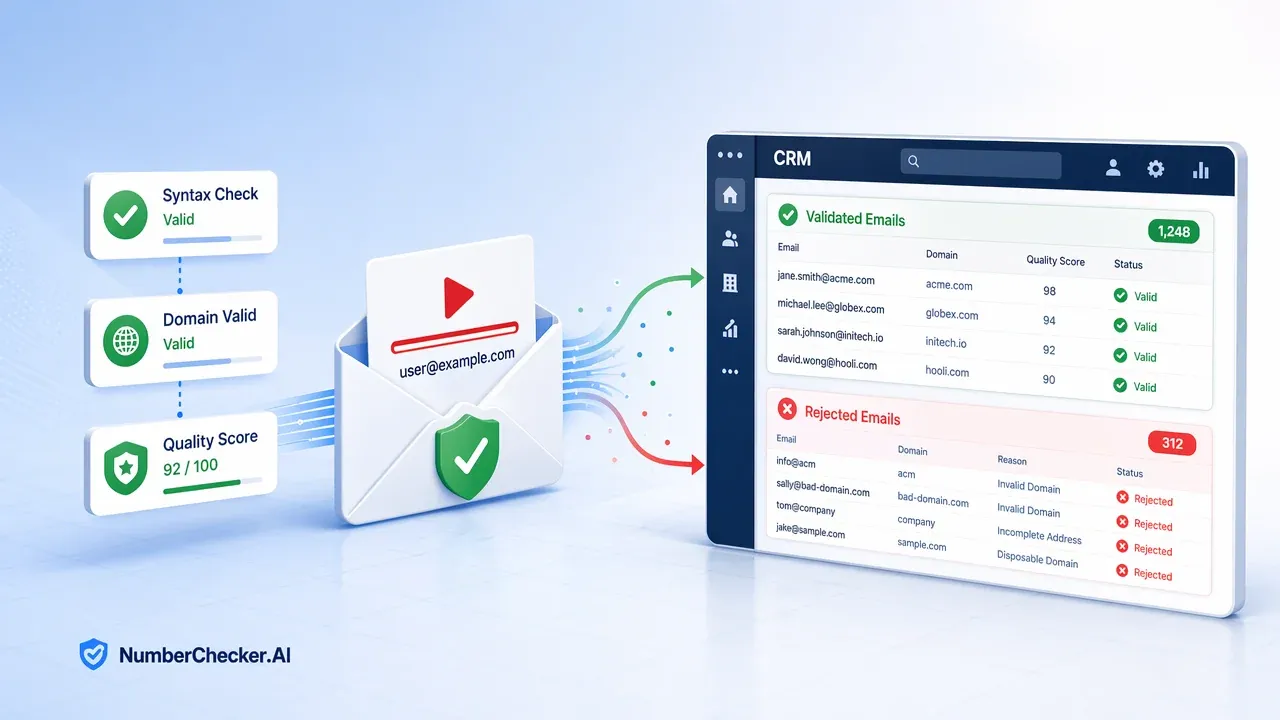
Netflix email validation helps businesses improve data quality by filtering out malformed, inactive, mistyped, or otherwise low-confidence email records before they create problems downstream. Used correctly, it supports cleaner operations, better workflow prioritization, lower compliance risk, and healthier day-to-day list management without turning a single validation step into an exaggerated identity claim.
Why data quality problems start earlier than teams expect
Most organizations think about bad data only after it shows up in reporting, support queues, or failed communications. In reality, the damage often begins the moment a low-quality record enters the system.
Email data is especially vulnerable. Errors at the point of capture, abandoned inboxes, formatting problems, and fake submissions all contribute to the decline of dataset quality over time. Once that data is accepted into internal systems, it affects everything built on top of it: routing logic, customer intelligence, campaign performance, and compliance reporting.
This is why Netflix email validation matters. It is not just about confirming whether an address “looks okay.” It is about protecting the integrity of the workflows that depend on that address.
What “better data quality” really means
In operational terms, better data quality means more than fewer typos. It means data that is:
- accurate enough to support action;
- consistent across systems;
- current enough to remain useful;
- trusted by the teams that rely on it.
That matters because low-trust data has a compounding cost. A questionable email record can trigger wasted outreach, bad segmentation, support confusion, and misleading metrics. At scale, those small errors become an expensive pattern.
This is one reason data integrity is treated as a strategic concern by mature operations teams. Reliable contact data improves not only communication outcomes, but also the confidence people have in the wider operating system.
How Netflix email validation improves operational efficiency
Operational efficiency improves when teams spend less time fixing preventable issues and more time acting on high-confidence records. In practice, that also means less list decay noise, cleaner uploads, and fewer avoidable errors flowing into downstream tools.
Netflix email validation supports that shift in a few practical ways.
1. It blocks weak data before it spreads
When validation happens close to the point of entry, low-quality records are less likely to contaminate CRM systems, automation tools, or analytics environments. That saves time that would otherwise be spent cleaning up avoidable errors later.
2. It reduces manual review volume
Not every record requires the same attention. Validation outputs can help teams separate obviously problematic entries from cleaner ones, allowing operations or risk teams to reserve manual review for genuinely ambiguous cases.
3. It makes automation safer
Automated workflows are only as good as the data feeding them. If the input layer is unreliable, downstream automation can become expensive very quickly. Validation adds a control point that helps keep automation aligned with better-quality records.
4. It improves reporting trust
Metrics become more useful when they are built on cleaner data. Better validation does not solve every reporting problem, but it reduces one important class of distortion: actions driven by records that never should have entered the system in the first place.
Why continuous validation is often better than periodic cleanup
Many businesses still treat validation as a one-time hygiene project. That is usually not enough. Email datasets decay continuously, which means one-off cleanup tends to lose value quickly.
A more durable model is continuous or repeated validation at key workflow stages. For example:
- at initial capture;
- before sensitive onboarding decisions;
- before major outbound activity;
- during periodic database maintenance.
This approach is more operationally useful because it reflects how data actually behaves in the real world: it changes, degrades, and becomes stale unless the system actively accounts for that.
Reducing compliance and security risk
Poor-quality contact data is not just an efficiency problem. It can also create privacy, consent, and governance issues.
If a business is storing, routing, or acting on inaccurate account-related email data, it may also be increasing its compliance exposure. That is especially true when validation-sensitive workflows touch fraud review, onboarding, or regulated communications.
Netflix email validation helps by making it easier to:
- remove obviously weak records earlier;
- reduce unnecessary retention of low-value data;
- enforce clearer quality gates in operational pipelines;
- document validation as part of broader control processes.
That does not automatically make a workflow compliant, but it does make it easier to run a better-controlled environment.
A practical implementation model
Businesses usually get the best results when validation is built into normal operations rather than handled as an isolated technical project.
A practical implementation often looks like this:
- validate email records at intake or upload;
- classify results into usable workflow categories;
- route low-confidence records for extra review or rejection;
- use the validation outcome as one signal in prioritization logic;
- monitor the downstream impact on bounce rate, support burden, and review efficiency.
This creates a cleaner operating loop. Instead of repeatedly reacting to weak data, the organization starts reducing preventable issues at the front door.
Conclusion
Netflix email validation improves data quality because it gives businesses a structured way to catch weak records before they create wider operational damage. That directly supports better efficiency: fewer cleanup tasks, more reliable automation, stronger reporting inputs, and more disciplined review workflows.
Its value is not in making bold claims about users. Its value is in making data operations calmer, cleaner, and more dependable over time.
Frequently Asked Questions
Is Netflix email validation only useful for fraud teams?
No. It can also help CRM, growth, operations, and compliance teams by improving input quality and reducing downstream errors.
Does validation solve data quality on its own?
No. It is one important control point, but it works best alongside good capture practices, governance, and ongoing database maintenance.
Why is continuous validation better than a one-time cleanup?
Because email data changes over time. A one-time cleanup improves the dataset temporarily, while repeated validation helps preserve data quality longer.
Should businesses treat a validated email as proof of identity?
No. Validation should be treated as a supporting signal, not as a standalone determination of identity or trustworthiness.
Ready to get started?
Try our WhatsApp number validation service and see the difference clean data makes.

