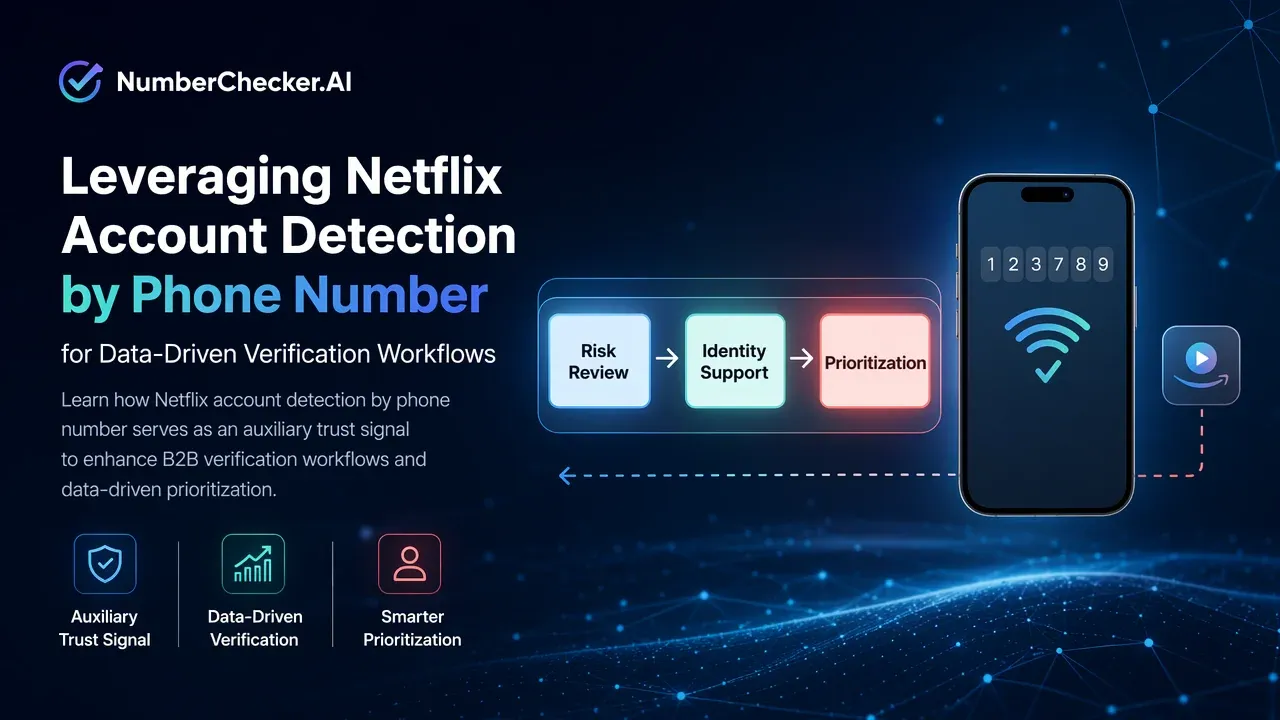
Leveraging Netflix Account Detection by Phone Number for Data-Driven Verification Workflows
Learn how Netflix account detection by phone number serves as an auxiliary trust signal to enhance B2B verification workflows and data-driven prioritization.
Netflix account detection by phone number can help risk and operations teams add an extra trust signal to verification workflows. Used carefully, it supports data-driven prioritization by showing whether a number appears to be linked to an active streaming profile. Used carelessly, it risks being overinterpreted. The real value lies in treating it as one supporting input among many and in using it to keep list-based and verification workflows more focused.
Why verification teams increasingly rely on layered signals
Modern verification and risk operations rarely depend on a single binary check. Teams usually combine first-party data, behavioral signals, device information, workflow history, and external indicators to build a more balanced view of a record.
That layered model exists for a reason: most signals are useful, but few are decisive on their own.
Netflix account detection by phone number fits well into that model. It is not strong enough to stand in for identity verification, but it can still improve prioritization and reduce uncertainty when used as part of a broader framework.
What makes phone-number-linked streaming signals useful
Streaming platforms use phone numbers for practical security functions such as account recovery, login checks, and verification codes. This matters because it gives the number a functional role inside a real-world trust system.
For B2B workflows, that can make a phone-number-linked account signal operationally interesting. A number associated with an active consumer service may carry more practical confidence than a bare contact record with no supporting context.
This does not mean businesses should treat the signal as proof of ownership or intent. It means the signal may help:
- narrow review queues;
- prioritize cleaner records;
- support low-friction routing decisions;
- strengthen data-driven qualification logic.
A practical way to think about the signal
The most useful framing is not “Is this enough to trust the user?” but rather “Does this improve the overall quality of the decision?”
That is an important distinction. In operational settings, the goal is usually not to eliminate all uncertainty. It is to reduce avoidable uncertainty at the right stage of the workflow.
If a number appears linked to an active Netflix account, that may support a lower-risk interpretation. If it does not, the result may justify additional review. In either case, the signal helps shape workflow treatment rather than dictate the final verdict.
Where businesses may apply it
Verification workflows
Teams can use the signal to inform whether a record should move through a standard path or be escalated for additional checks.
Data-driven prioritization
When businesses need to sort large volumes of records, auxiliary trust signals help determine where human attention is most valuable.
Fraud operations
In fraud review, this kind of detection may contribute to broader risk scoring, especially when paired with device, velocity, or behavioral indicators.
Dataset qualification
For operations teams working with large phone-based datasets, account-detection signals can help classify records into more actionable confidence buckets, making lists easier to prioritize and less noisy to work through.
Why overreliance is the biggest risk
The main mistake businesses make with signals like this is assigning them too much meaning. A positive match can be useful, but it does not tell the whole story. A negative result can also be informative, but it does not automatically indicate fraud.
That is why strong implementations tend to follow a few rules:
- treat the result as supportive, not definitive;
- use it alongside stronger primary data;
- avoid fully automated high-impact decisions based on this signal alone;
- document how it influences workflow routing and review.
This keeps the signal useful without turning it into an unstable shortcut.
Compliance, minimization, and responsible deployment
Phone-number-based account signals should be deployed with a clear governance model. Businesses need to ensure that the check is proportionate to the use case and that only the minimum useful output is retained.
In practice, that usually means:
- defining a specific business purpose for the detection step;
- limiting retention to the smallest useful result set;
- aligning the workflow with user consent and disclosure requirements where applicable;
- ensuring the signal is not repurposed into opaque profiling.
This is especially relevant for European and UK-facing businesses, where data minimization and lawful processing are central requirements rather than best-effort recommendations.
Frequently Asked Questions
Is Netflix account detection by phone number a replacement for KYC?
No. It is better understood as an auxiliary trust signal that may support a larger verification stack.
Why can this help prioritization?
Because it may help teams distinguish between records that look somewhat stronger and those that require more scrutiny, improving how review resources are allocated.
Can businesses automate decisions based on this alone?
They should be cautious about doing so. The signal is most useful when combined with first-party data, behavior, and additional checks.
What makes this compliant in practice?
A clear business purpose, proportionate use, minimal retention, and alignment with privacy and consent requirements.
Ready to get started?
Try our WhatsApp number validation service and see the difference clean data makes.

