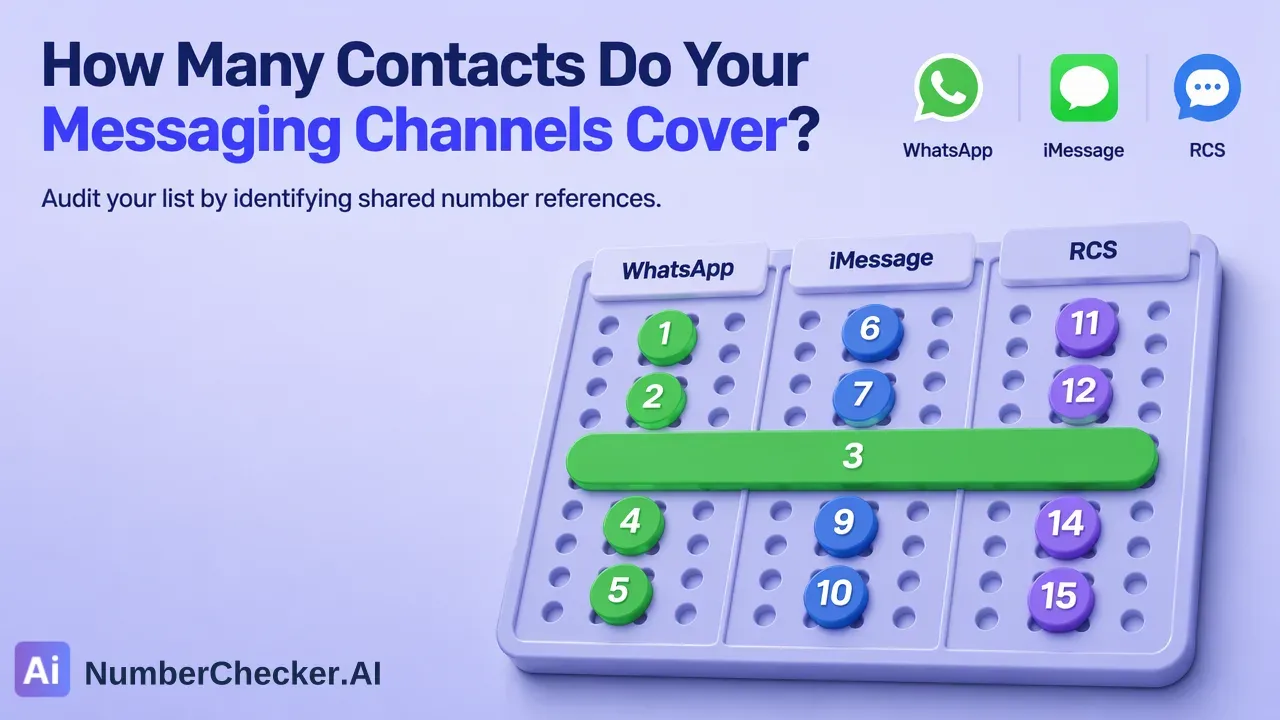
How Many Contacts Do Your Messaging Channels Really Cover?
Count distinct numbers across WhatsApp, iMessage and RCS observations without adding overlapping channel totals or promising delivery.
A number can appear in more than one messaging-channel result. Adding WhatsApp, iMessage and RCS totals therefore overstates the distinct numbers represented whenever those groups overlap. To estimate a combined audience, keep one record per normalized number, preserve each channel observation separately, and count the union after applying the eligibility rules for your intended message.
Name the unit before counting the audience
A marketing team preparing a delivery reminder may have 1,200 order records but fewer distinct phone numbers. Some customers placed more than one order; some records share a household or business number. Counting orders, CRM rows and phone numbers gives different answers before any channel checks begin.
Choose the unit that matches the report. For a number-level channel estimate, deduplicate the working list by the prepared number while retaining links to the original customer or order records. Call the result “distinct numbers,” not “unique people.” A number can be shared, and one person may supply several numbers.
Then keep a separate observation for each selected service. NumberChecker’s WhatsApp checker, iMessage Checker and RCS Checker answer their own platform-registration or support questions. They do not become one combined reachability fact simply because the results are joined into the same sheet.
Count the overlap once
Consider this hypothetical five-number worksheet. A plus means the selected check supplied the relevant positive observation; a dash means no positive observation is being counted for that channel in this illustration. Real unresolved results should retain their own labels.
| Number reference | iMessage | RCS | |
|---|---|---|---|
| A | + | + | - |
| B | + | - | + |
| C | - | + | - |
| D | + | + | + |
| E | - | - | - |
WhatsApp has three positive observations, iMessage has three and RCS has two. Adding them gives eight channel observations. The combined group contains only four distinct number references: A, B, C and D. D appears in all three groups but contributes one number to the combined count.
This is the union: include a number once if it belongs to at least one relevant group. An intersection answers a different question. For example, the WhatsApp-and-iMessage intersection contains A and D. That count can help describe channel choice within the list, but it should not be added to the union again.
For three channels, a single row with a flag for each channel makes the calculation easier to inspect than repeatedly adding and subtracting summary totals. Filter for at least one eligible positive observation and count the remaining distinct normalized numbers. The arithmetic belongs to your spreadsheet or analysis tool, not to an assumed NumberChecker audience-dashboard feature.
Apply permission and preference before reporting eligibility
The raw overlap describes the observations in the submitted list. An audience for a particular message also depends on your customer records and channel arrangement. Apply current opt-outs, contact permissions and the purpose of the communication through your own process.
Suppose number B has positive observations for WhatsApp and RCS but your customer records permit the reminder only through the chosen RCS route. Keep both observations, while counting B once in the eligible combined audience for that message. If number D has opted out of this communication, remove it from that audience rather than letting its three positive observations keep it in.
A customer’s preference also helps you choose one route when several remain available. The combined count does not instruct a team to contact the same customer through every supported channel. Store the selected route separately from the raw observations, so a later preference change does not require rewriting the checker history.
Check that all compared results refer to the same intended list and retain their dates. A union built from one recent file and two much older exports can hide mismatched inputs and observation times. Where data is missing, report the unresolved group separately instead of counting it as a confirmed negative or assuming support.
Distinguish an estimate from a delivered audience
Your final report can be precise without overstating the result: “Four distinct numbers have at least one positive channel observation in this example; the eligible number count is calculated after current message-specific filters.” Keep per-channel totals available for planning, but label them as channel observations rather than extra people.
Actual message delivery remains a later event in the selected sending system. A platform-registration or support observation does not guarantee delivery, attention or a reply. Use delivery records when reporting what happened after a send, and keep them separate from this pre-send list estimate.
For the next campaign, take one normalized-number table and add only the named checks the message plan needs. Our RCS product and API documentation help you confirm the selected service before you calculate the combined audience in your own worksheet.
Get Started with NumberChecker.AI
Explore NumberChecker.AI’s supported bulk list-checking products and choose the capability that fits your workflow.
Ready to get started?
Try our WhatsApp number validation service and see the difference clean data makes.

