How MAX Full Info Checker Improves Customer Segmentation and Sales Priorities
Learn how MAX Full Info Checker enriches CRM data using public profile signals for customer segmentation and sales optimization while respecting privacy.
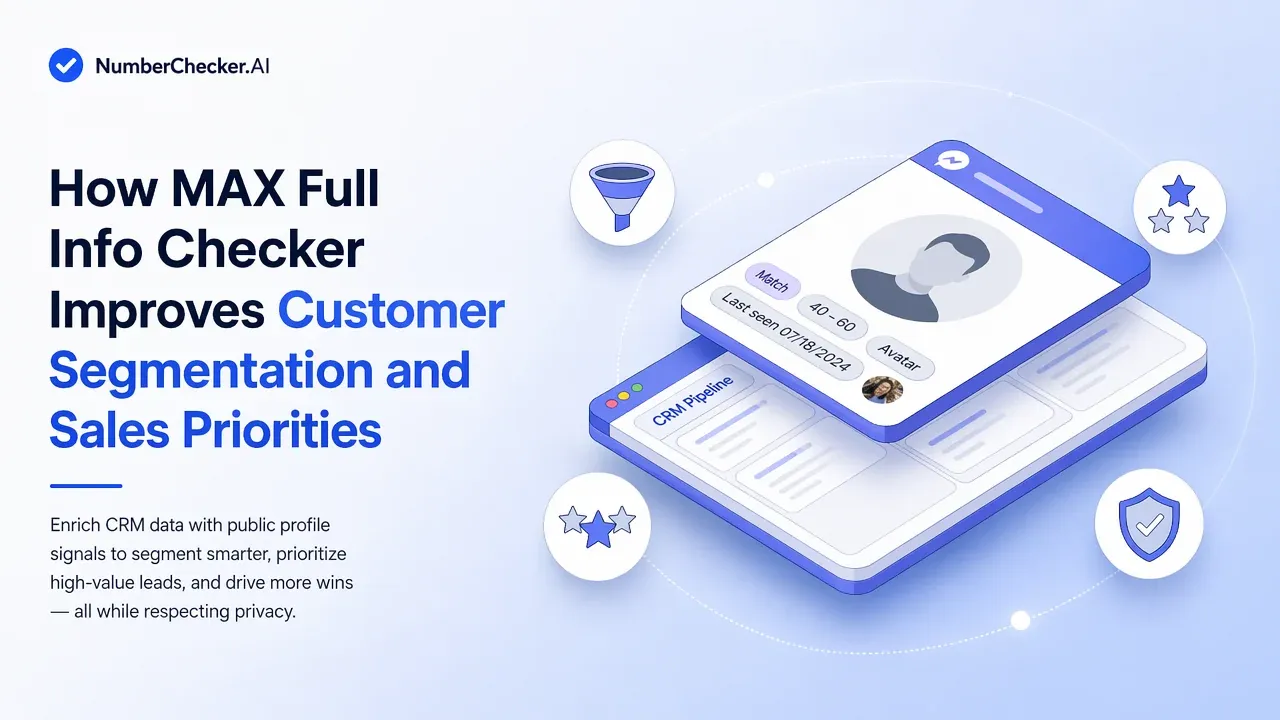
MAX Full Info Checker helps enrich CRM profiles with signals such as gender, age, last seen, and profile photo. For sales and marketing teams, that is a practical way to make segmentation sharper, prioritize the database more clearly, and pick better moments for outreach—without pretending it replaces full customer analytics. Operationally, it makes the database not just richer but easier to work with day to day.
Why segmentation suffers without extra context
In many companies the segmentation problem is not a lack of tools—it is thin source data. A CRM contact might have a phone number, a name, and a few system tags, but that is often not enough to decide how to work the lead next.
Teams then default to broad plays: the same plays for different groups, weaker lead prioritization, and more time spent manually scanning the database.
Data enrichment closes part of that gap. When additional signals sit alongside the base profile, the business has a stronger basis for careful segmentation and more precise operational calls.
What MAX Full Info Checker provides
MAX Full Info Checker is built to return extra details about a MAX account profile. Depending on availability, that can include:
- gender;
- age;
- last activity time;
- avatar.
None of these fields should become the sole criterion for judging a customer. Combined with CRM history, behavioral data, and funnel logic, they are useful supporting context.
So it is more accurate to talk not about “fully understanding the customer,” but about strengthening the working picture: managers and marketers get a bit more material for grounded actions.
How it helps segment your database
Segmentation works better when teams can split audiences not only by lead source or deal stage, but also by traits that help tune messaging.
Data from MAX Full Info Checker can help when you need to:
- pre-split the base into groups that fit different offers;
- adjust tone of voice and the structure of first touch;
- surface segments with different engagement likelihood;
- run sharper manual or semi-automated prioritization.
For example, channel activity can inform when to contact someone. Basic demographic traits can support cautious personalization. An avatar can be a secondary cue in manual lead review. None of this replaces judgment, but it reduces blunt one-size-fits-all plays.
Lead prioritization: where practical value appears
Sales teams rarely need “one more interesting datapoint” in isolation. They need a faster read on where to send effort.
When the system adds profile signals, it becomes easier to:
- sort leads by how current they feel;
- surface contacts more likely to respond;
- allocate work across reps more evenly;
- avoid flooding the team with low-probability outreach.
Last seen is especially useful here. It does not guarantee outcomes, but it hints at how “live” a contact looks in the channel. For sales it is not a magic score—just a practical cue for sequencing. For CRM and operations teams it is an extra marker when working segments every day.
Important caveat: auxiliary signals only
This is the line between useful enrichment and over-weighting data. Gender, age, avatar, or activity timing should not be the only basis for scoring, rejecting a lead, or running heavy automated decisions.
A sound usage model looks like this:
- start with first-party data and interaction history;
- add behavioral and operational signals;
- then use profile fields as an extra layer of context.
That reduces bias and keeps interpretation sane. Otherwise you risk a more complex model that is not actually more accurate.
Privacy and compliance
Working with extra profile data always demands care. Even when you treat it as auxiliary, you still need transparency, minimization, and lawful processing.
In practice that means:
- collect only what the specific workflow truly needs;
- do not use these signals for covert or disproportionate profiling;
- limit internal access inside CRM and operational tools;
- respect local law and broader privacy frameworks.
For mature businesses that is not extra bureaucracy—it is how you balance precision with user trust.
Conclusion
MAX Full Info Checker is valuable not because it adds “more data in general,” but because it helps turn a raw CRM base into a more manageable working asset. Extra profile signals let teams segment more precisely, prioritize more carefully, and plan contact timing with better judgment.
The approach pays off most when those signals are used in moderation alongside core analytics—improving sales and marketing decisions without turning enrichment into questionable or excessive profiling.
Frequently Asked Questions
What data can MAX Full Info Checker return?
Typically signals such as gender, age, avatar, and last activity time—when available for that profile.
Can I use this for automated lead scoring?
Only as one factor among many. It should not be the sole source of lead evaluation.
Why is last seen useful for sales?
It gives a rough sense of how active the contact is in the channel and can inform better timing for outreach.
Do privacy requirements still apply?
Yes. Even auxiliary profile signals must be handled with consent, data minimization, and standard personal-data rules in mind.
Ready to get started?
Try our WhatsApp number validation service and see the difference clean data makes.

