Managing WhatsApp and Telegram Bulk List Signals
Learn why CRM teams must manage WhatsApp and Telegram bulk list signals in separate data columns to maintain data integrity and support accurate segmentation.
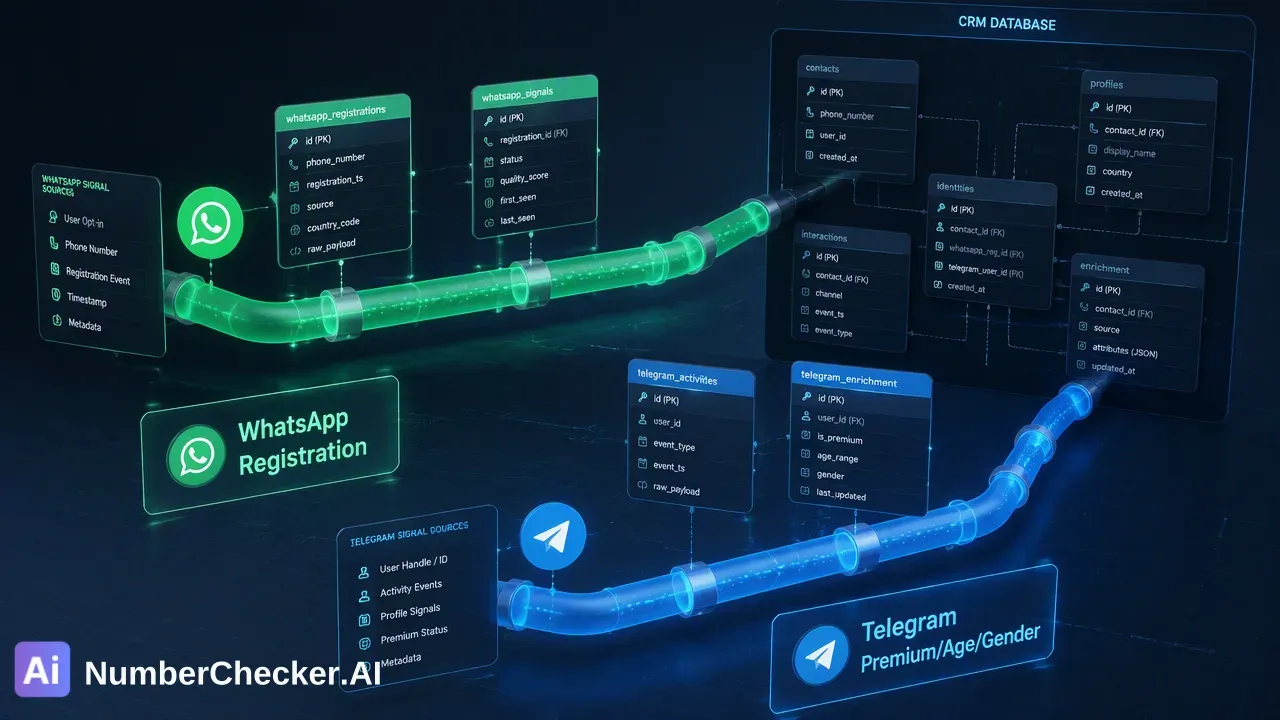
To maintain data integrity and operational precision, organizations must store WhatsApp and Telegram signals in separate database columns. Because each platform provides unique signal types—ranging from basic registration status to detailed profile enrichment—merging them into a single generic flag obscures critical differences in account presence. Maintaining distinct columns supports accurate audience segmentation and ensures that CRM administrators can effectively manage bulk list signal management workflows without losing platform-specific context.
The Importance of Signal Granularity
Data architects and marketing operations managers frequently process large contact lists across multiple communication channels. When handling these lists, maintaining signal granularity is a fundamental requirement for database hygiene. Platform signals are not interchangeable and require distinct storage schemas. Different products expose different high-level capabilities, and a capability must not be transferred from one product to another. For example, a WhatsApp registration signal confirms account presence on that specific platform, while Telegram checks may return entirely different contextual data. If a data analyst attempts to map both platforms into a single generic column, the database loses the ability to differentiate which platform the signal belongs to. This conflation limits the utility of the data, as teams can no longer segment audiences based on platform-specific presence. By isolating WhatsApp and Telegram data into dedicated columns, organizations preserve the exact nature of the signal, supporting more precise workflow routing and internal decision-making.
Understanding Platform-Specific Signal Types
To design an effective CRM schema, teams must understand the structural differences between basic registration signals and deeper profile enrichment data. A platform registration signal simply indicates the presence of an account associated with a specific platform for a given phone number. However, Telegram signals vary significantly in depth depending on the specific check performed. The standard Telegram Checker provides a platform registration signal, an account identifier signal, and a membership signal, offering context on available usernames and Premium-membership status. The Telegram Days Checker expands on this by adding an activity signal, which provides available activity or last-seen context alongside the registration and membership data. Furthermore, the Telegram Avatar, Age, Gender & Others Checker introduces profile and demographic enrichment, supplying additional context associated with the registered account. Because WhatsApp registration signals and these varied Telegram enrichment signals represent entirely different data structures, they cannot be accurately represented in a shared database field.
Operational Risks of Merged Data Columns
Merging heterogeneous platform signals into a single column introduces significant operational risks and technical debt. The most immediate risk is data corruption caused by forcing incompatible signal types into a single boolean field, such as a generic validity flag. This practice strips away the nuanced context provided by specialized checkers. When signals are merged, a CRM administrator cannot distinguish between a basic WhatsApp registration and a Telegram profile that includes demographic enrichment and activity signals. This loss of context creates operational inefficiency, as marketing operations managers are unable to build accurate segments or route contacts based on platform-specific criteria. Additionally, treating a platform registration signal as a universal indicator of phone number validity or reachability is a structural error. Merging columns exacerbates this error by blending distinct platform presences into a misleading aggregate metric.
Best Practices for Schema Design in Bulk Workflows
Implementing a robust data architecture requires dedicated columns for each platform’s specific signal type. The core workflow for these operations is the bulk checking of supported phone-number or email lists. Because these bulk workflows support CSV or TXT list uploads and REST API access, the resulting data outputs must be mapped to a schema that accommodates platform-specific fields. CRM administrators should create distinct columns for WhatsApp registration status and separate columns for Telegram-specific data points, such as Telegram registration, Telegram username, Telegram activity status, and Telegram Premium membership. This structured approach ensures that when bulk check results are ingested via CSV or API, the data populates the correct fields without overwriting or conflating cross-platform signals. Maintaining this strict separation supports accurate segmentation, informs internal decisions, and provides data analysts with a clear, reliable foundation for managing multi-platform marketing operations.
Frequently Asked Questions (FAQ)
Why can’t organizations use a single ‘active’ column for both WhatsApp and Telegram?
Using a single column conflates distinct platform signals and causes a loss of critical context. Different products expose different high-level capabilities, meaning a WhatsApp registration signal and a Telegram enrichment signal represent entirely different data points. Merging them obscures which platform the account is registered on and limits the ability to segment audiences accurately.
How does profile enrichment differ from a standard registration signal?
A standard platform registration signal only indicates the presence of an account associated with a specific platform for a given phone number. In contrast, profile enrichment provides deeper context. For example, specific Telegram checks can return an activity signal, demographic enrichment, or Premium-membership context alongside the basic registration data.
What is the best way to structure bulk check results in a CRM?
The most effective approach is to use dedicated columns for each platform’s specific signal type. Since bulk workflows support CSV or TXT list uploads and REST API access, CRM administrators should map the output to separate fields—such as one for WhatsApp registration and others for Telegram activity or demographic enrichment—to maintain data integrity and support precise workflow management.
Get Started with NumberChecker.AI
Explore NumberChecker.AI’s supported bulk list-checking products and choose the capability that fits your workflow.
Ready to get started?
Try our WhatsApp number validation service and see the difference clean data makes.

