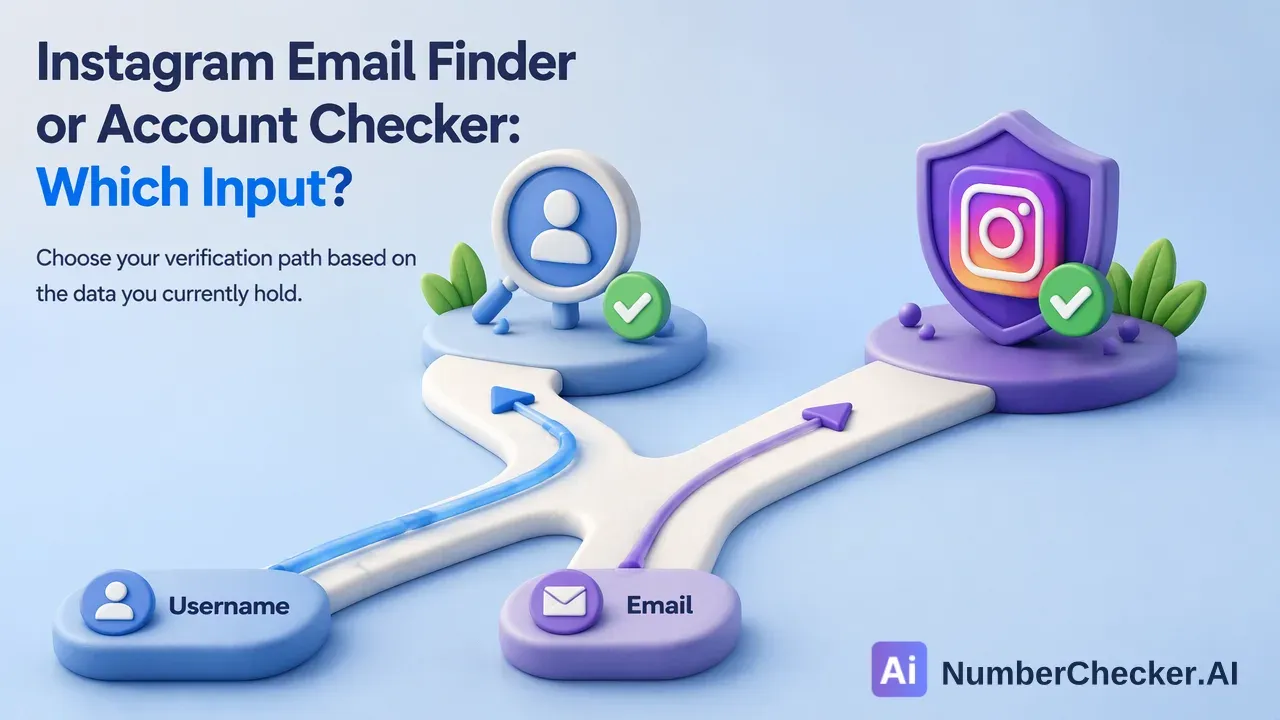
Instagram Email Finder or Account Checker: Which Input Do You Have?
Start with the identifier you already hold. Compare username-to-public-email discovery with checking a supplied email list for an Instagram account signal.
An Instagram email finder starts with an account name and looks for a publicly available contact address. An Instagram account checker starts with an email address you already hold and asks whether it has an Instagram account signal. Choose by your input and the decision you need to make, not by the similar names.
Two requests that sound alike but run in opposite directions
A partnerships team has a spreadsheet of Instagram usernames from creators who asked for a collaboration brief. Its question is whether those creators have published a business email. That is a discovery task. The starting cell is an account identifier; the desired new cell is a public contact address, if one is available. An email finder may search public profile information for that address. An empty result simply leaves the team without a discovered address.
A different team has addresses that people supplied through its own form. It wants to understand whether those existing addresses have an Instagram account signal. This is a checking task. The starting cell is an email address, and the output concerns that same address. The checker is not asked to discover an address from a handle. The distinction matters because buying the wrong direction cannot answer the team’s question, even if both tools mention Instagram and email.
Write the question at the top of your worksheet: “What do we know already?” Put username or profile URL in one column, and email address in another. If the email column is blank, an existing-email check has no input. If the handle column is blank, a username-based finder has no starting identifier. That simple check avoids treating one type of result as a substitute for the other.
Where NumberChecker fits when the email is already known
NumberChecker is designed around checking customer-supplied lists. Its Instagram Email Checker takes supplied email addresses and reports an Instagram account-presence signal for those addresses at check time. It is useful when the team already has an authorized list and needs to segment or review that list for a specific platform question. It does not extract contact details from profiles or reverse a username into an email address.
For a list workflow, keep the source and purpose of each address beside the check result. A CRM export might mix addresses entered by customers with addresses copied from unrelated public pages. The signal answers the platform question for the supplied address; it does not repair how the list was acquired. The team can prepare a relevant subset, submit the supported file task, and review completed results against its original rows. The service’s bulk task workflow uses CSV or TXT input and a completed downloadable ZIP for customer review. Treat the export as a dated observation, not as a permanent profile attribute.
If a colleague asks whether NumberChecker found an email for a particular creator, the answer is no: that was not the input or output of this service. Say instead that an email the team already had was checked for an Instagram account signal. Clear wording prevents a downstream salesperson from contacting a person under the false impression that a handle and an address have been linked by the checker.
A useful decision sheet for the next step
Keep three separate questions in the handoff: identifier, observation, and relationship. The identifier is the value submitted, such as an email address. The observation is the completed platform-specific signal and its check date. The relationship is why the team believes that address belongs in its customer or creator record. A check result can inform the second line; the customer relationship needs separate evidence from the team’s own interaction.
For the partnership example, a public email shown on a creator profile can be a lead for a relevant inquiry, subject to the team’s own permission and outreach rules. It is not automatically proof that the profile owner controls the mailbox today. For the customer-form example, an Instagram account signal does not establish that the customer owns the account, that messages to the address will arrive, or that the customer agreed to Instagram outreach. Those questions call for separate confirmation or a different workflow.
A practical review note could read: “Address supplied in our signup form; Instagram email signal observed on this date; account relationship unconfirmed.” That note tells the next teammate what the check contributed without implying an identity match. If the result is unavailable or inconclusive, keep that state visible rather than converting it into a negative answer. If the question is email deliverability, evaluate that separately; an Instagram account signal is not a mailbox delivery test.
Choose the tool by the missing piece
Before paying for either category, select a handful of representative rows and state the missing piece for each. A username with no address calls for public contact discovery. A supplied address with an account question calls for an Instagram email check. A customer record needing proof of control needs confirmation from that customer. A campaign needing permission or delivery information needs those decisions in its own channel workflow.
This order keeps the purchase aligned with the real task. If your team already has the email list and wants the platform-specific observation, review the Instagram Email Checker within NumberChecker and prepare only the relevant customer-supplied addresses. If it has only usernames, first decide whether public contact discovery is appropriate for that project. In either case, keep the source of the identifier beside any later check result.
Frequently Asked Questions (FAQ)
Can an Instagram account checker find an email from a username?
No. NumberChecker Instagram Email Checker checks email addresses supplied by the customer. A username-to-public-email search is a different task.
Does an account signal verify the person behind the address?
No. It is a platform-specific observation at check time. Confirm identity, ownership and contact permission through the relevant customer relationship.
Get Started with NumberChecker.AI
Explore NumberChecker.AI’s supported bulk list-checking products and choose the capability that fits your workflow.
Ready to get started?
Try our WhatsApp number validation service and see the difference clean data makes.

