Evaluating Contact Screening Tools for Enterprise Data Hygiene
Learn how to evaluate enterprise contact screening tools for data hygiene, focusing on bulk workflows, REST API integration, and carrier intelligence.
Effective enterprise contact screening tool evaluation requires prioritizing platforms that support bulk processing via CSV or TXT list uploads and REST API access. When assessing data hygiene solutions, evaluation should focus on a tool’s ability to provide specific, actionable signals rather than relying on generic validation methods. Two critical capabilities to look for are carrier intelligence, which provides regional and line-type context, and platform-specific registration checks, which support targeted audience segmentation. A robust screening workflow integrates these distinct signals directly into customer relationship management (CRM) systems or data pipelines to maintain long-term data accuracy and support internal outreach planning.
The Role of Contact Screening in Enterprise Data Hygiene
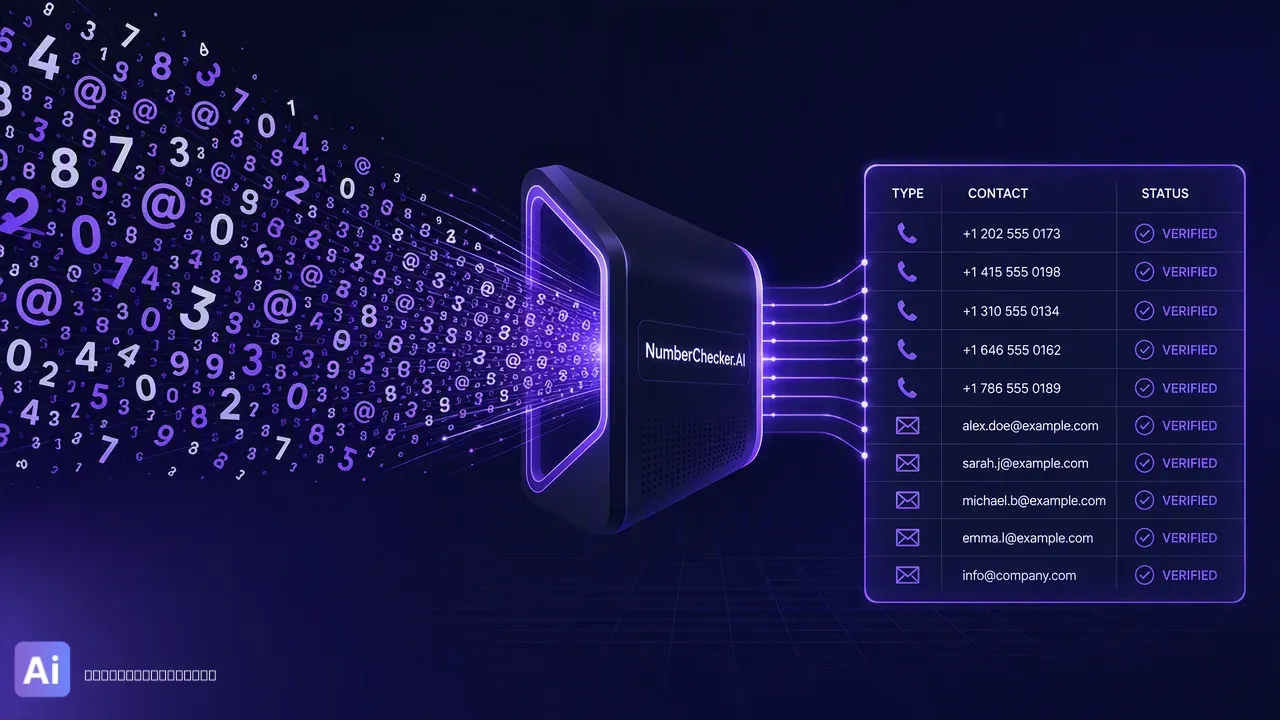
Maintaining clean, accurate, and up-to-date contact information within a CRM or marketing database is a fundamental practice known as data hygiene. For large organizations, manual list management is inefficient and prone to errors, making automated contact screening a critical component of data operations. Contact screening is the process of validating and enriching contact lists to support the effectiveness of outreach workflows. At the enterprise scale, single-number lookups are insufficient. Bulk verification workflows are the standard for maintaining CRM health and optimizing outreach. By processing large volumes of contact data simultaneously, organizations can systematically identify outdated or incorrectly formatted entries. This systematic approach to data hygiene helps teams review their databases efficiently, supporting better prioritization and informing internal decisions regarding contact strategies. Evaluating tools based on their capacity to handle bulk lists ensures that the chosen solution can scale alongside the organization’s growing data requirements.
Key Evaluation Criteria for Screening Tools
When conducting an enterprise contact screening tool evaluation, technical and operational requirements must guide the selection process. The core workflow of an enterprise-grade tool should center on the bulk checking of supported phone-number or email lists. First, evaluate the input methods. Tools must support bulk workflows through standard file formats, specifically CSV or TXT list uploads, to accommodate non-technical users managing large datasets. Second, REST API access is necessary for automated pipeline integration, allowing data engineers to connect the screening service directly to existing infrastructure. Third, assess the diversity of signal types the tool provides. A comprehensive screening solution should offer distinct high-level capabilities, such as carrier intelligence and platform registration signals. It is important to note that different products expose different capabilities, and a capability must not be transferred from one product to another during evaluation. The ability to access specific, documented signals ensures that data teams can tailor their screening processes to the exact needs of their CRM workflows.
Understanding Signal Types: Carrier Intelligence vs. Platform Registration
A critical phase of enterprise contact screening tool evaluation involves differentiating between the types of data signals provided. These signals should be used for decision support and workflow context rather than as definitive proof of identity or user intent. Carrier intelligence provides structural context about a phone number. For example, a Global Carrier Checker can identify the carrier, line type, country, and regional context for phone numbers across supported countries. Similarly, an Advanced US Carrier Checker provides carrier, line type, and regional context specifically for United States and Canada phone numbers. This information helps teams segment lists based on geographic location or line type (such as mobile versus landline). In contrast, platform registration signals confirm account presence on specific networks. An iMessage Checker identifies iMessage-registered numbers in bulk. This specific signal supports iOS and Apple ecosystem audience segmentation, which can be one input into iMessage outreach or support planning. Platform-specific registration signals provide distinct segmentation data compared to general carrier intelligence, giving teams precise context for channel-specific workflows.
Integrating Screening into Data Pipelines
The practical application of contact screening tools relies on seamless integration into existing data pipelines. Automated batch workflows reduce the manual overhead associated with routine data cleaning tasks. By utilizing REST API access, data engineering teams can programmatically submit contact lists for bulk checking at scheduled intervals or triggered by specific CRM events. Integration with CRM systems allows for continuous data cleaning, ensuring that contact records are evaluated before they are utilized in active outreach campaigns. When a screening tool returns carrier intelligence or platform registration signals, these data points can be mapped to custom fields within the CRM. Ultimately, embedding bulk verification workflows directly into the data pipeline transforms contact screening from a periodic audit into a continuous, automated process that supports long-term enterprise data hygiene.
Frequently Asked Questions (FAQ)
What is the difference between carrier intelligence and platform registration checks?
Carrier intelligence identifies the underlying infrastructure of a phone number, providing details such as the carrier, line type, country, and regional context. Platform registration checks, such as an iMessage Checker, identify whether a number is registered on a specific service or network. While carrier intelligence offers geographic and line-type context, platform registration signals support specific audience segmentation, such as iOS and Apple ecosystem outreach planning.
Why is bulk verification preferred over single-number lookups for enterprise data?
Bulk verification workflows are essential for enterprise data hygiene because they allow organizations to process large volumes of contact data efficiently. Single-number lookups cannot scale to meet the demands of enterprise CRM systems or marketing databases. Tools that support bulk checking via CSV or TXT list uploads and REST API access reduce manual overhead and support automated, systematic data cleaning across extensive contact lists.
How can I integrate contact screening into my existing CRM workflow?
Contact screening can be integrated into existing CRM workflows by utilizing a tool’s REST API access to automate batch processing. Data teams can configure their pipelines to send contact lists for bulk checking, retrieving signals like carrier intelligence or platform registration data. These signals are then mapped back to the CRM, supporting continuous data cleaning, informing internal decisions, and helping teams segment audiences for targeted outreach.
Get Started with NumberChecker.AI
Explore NumberChecker.AI’s supported bulk list-checking products and choose the capability that fits your workflow.
Ready to get started?
Try our WhatsApp number validation service and see the difference clean data makes.

