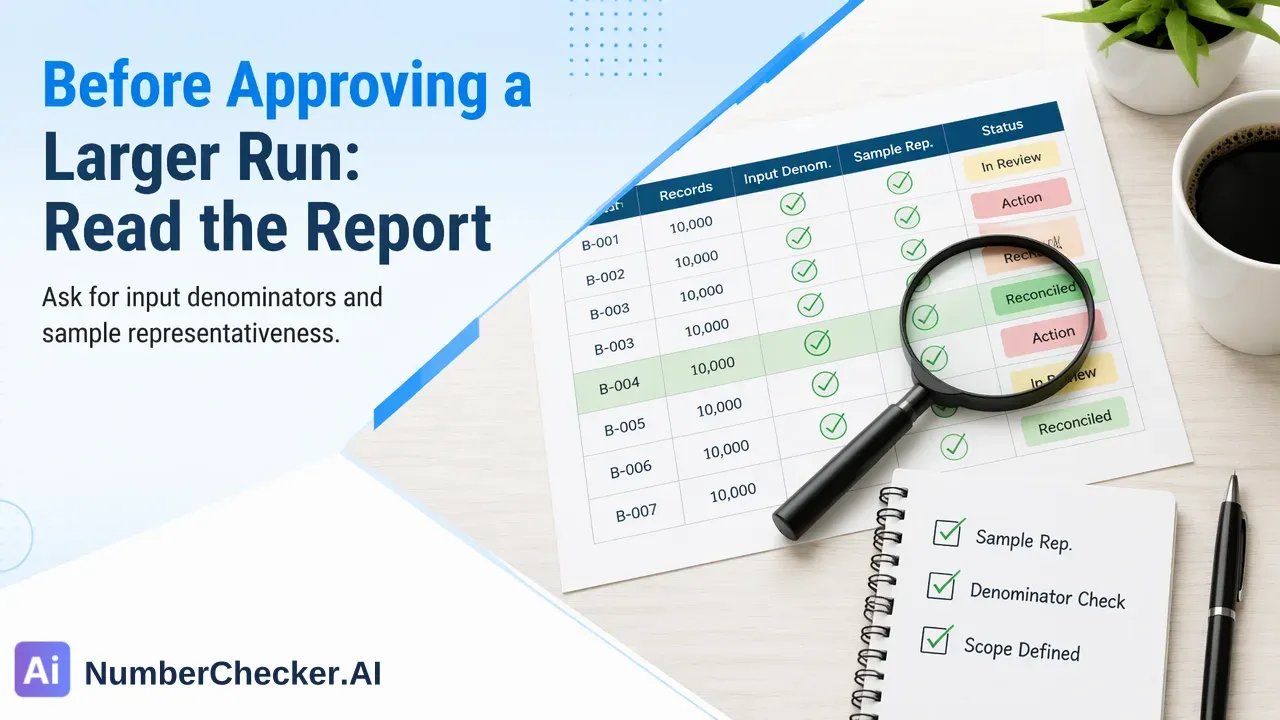
How to Read a Contact-Checker Trial Report Before Approving a Larger Run
Review sample fit, supported rows and unresolved findings before approving a larger contact-list check.
Approve a larger contact-list check only for the scope the trial actually demonstrated. Ask for the input denominator, a sample that resembles the intended list, counts of supported and unsupported rows, unresolved results, and a reconciliation from input to export. Keep registration or validation observations separate from ownership, permission and eventual response, which the trial did not measure.
Start with the decision the report must support
A trial report is useful when it lets a buyer decide whether to extend a particular check to a particular list. A headline percentage rarely does that. A trial drawn entirely from one country or one input type cannot establish how a broader, mixed list will behave. Ask the analyst to name the intended production list, the selected NumberChecker product, the submitted file, and why the sample resembles the work you are considering.
The report should describe how many records entered the trial, how many were duplicates or malformed before checking, and which records were eligible for the selected product. Those are different denominators. If the sample was deliberately cleaned, compare it with the raw list you will actually submit. A polished sample can hide the operational work needed to prepare the full file.
NumberChecker supports customer-controlled bulk list checks. Its products ask different questions, so do not combine results from a phone validation trial and a platform-registration trial into one accuracy figure. The buyer’s question is whether the named observation helps the intended workflow.
Reconcile every row before comparing outcomes
Request a row-level reconciliation, preferably using the buyer’s own reference ID. A concise report separates submitted records, records removed during preparation, records outside the selected product’s supported scope, completed positive and negative observations, and unresolved or failed rows. These groups should add back to the original input without silently treating an absent export row as a negative finding.
For example, if a product excludes unsupported providers from processing, results and billing, an absent address may simply be outside that product’s scope. It is not evidence that the address is invalid. Keep a separate reason column for such rows. When the export is a completed ZIP file, retain the original input and compare identifiers before calculating any rate.
A small, hypothetical worksheet makes the distinction visible:
| Group | Buyer question | Treatment |
|---|---|---|
| Eligible completed rows | What did the chosen check observe? | Report by result and date |
| Unsupported rows | What was outside the selected product? | Exclude from the measured-result denominator |
| Unresolved or failed rows | What still needs investigation? | Keep pending, with a reason |
| Removed input rows | What changed before checking? | Reconcile to the submitted list |
Ask for the actual counts and definitions for your trial. This table is a reporting design, not a claim about a universal export schema.
Separate measured signals from business outcomes
A platform-registration observation can tell you what the selected check reported at its check time. It cannot establish who owns the number, whether someone has agreed to contact, whether a message will be delivered, or whether the person will respond. Likewise, a phone validity observation is not a confirmed person match. If the analyst reports a single “accuracy” number, ask what ground truth was used and which outcome it measures.
The buyer can still evaluate usefulness without inventing a universal score. Compare the completed observations with customer records that the business already has a right to use, and document any known mismatches. Keep adjudicated examples separate from unchecked rows. If the intended outcome is a reply or a conversion, measure that later in the appropriate customer workflow; do not attribute it to this checker trial.
This distinction affects the purchase decision. A trial may demonstrate useful coverage for one country and product but leave another segment unresolved. It may justify a narrowly scoped next run, even when it cannot justify expanding to every record.
Write a specific approval or hold decision
The signoff should say which product and segment may move forward, who will review exceptions, and what evidence is still missing. Approve the supported scope when the sample is representative enough for that scope, row counts reconcile, and the observation serves a defined use. Narrow the next run when an unsupported provider or country creates a separate population. Hold expansion if the source file cannot be reconciled, if unresolved rows are being counted as negative, or if the claimed business outcome was never measured.
Consider two illustrative decisions. A team may approve a second file limited to the same supported input type after a clean reconciliation, while separately investigating a new country. Another team may pause because its analyst cannot link exported rows to the original customer references. Neither decision requires a fabricated accuracy threshold.
Preserve the trial report with the selected product, file preparation notes, check date and decision owner. For the next run, consult the NumberChecker API documentation for the selected workflow and current input requirements. A useful trial ends with a bounded action, not a broad promise about everyone on the list.
Get Started with NumberChecker.AI
Explore NumberChecker.AI’s supported bulk list-checking products and choose the capability that fits your workflow.
Ready to get started?
Try our WhatsApp number validation service and see the difference clean data makes.

