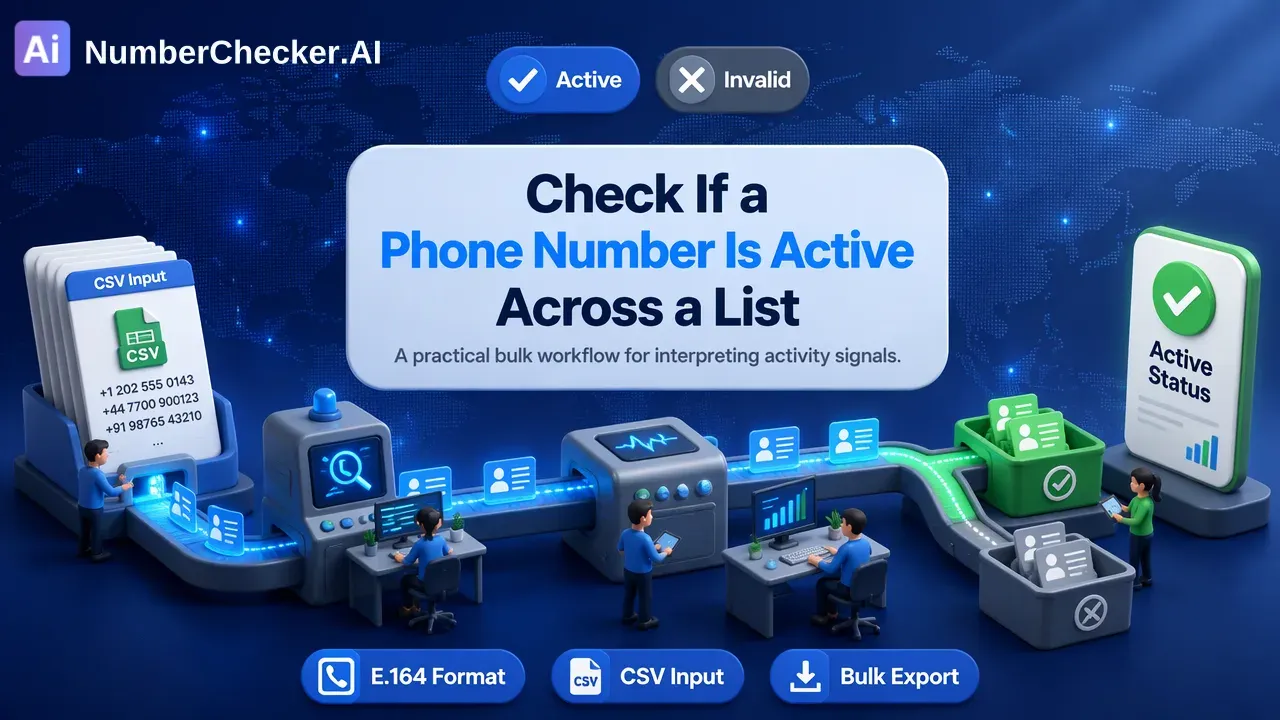
How to Check If a Phone Number Is Active Across a List
Prepare a country-specific list, run Number Active Checker, and use the activity signal for prioritization while keeping validity and consent separate.
To check if a phone number is active across a list, prepare the phone records, submit the country-specific file to Number Active Checker, and review its activity signal in the completed results. Use that signal to prioritize a list, not to predict whether a person will answer. If the initial question is whether a number is valid, Phone Number Validation is a separate check.
What does it mean to check if a phone number is active?
“Active” can describe several different questions: whether a number is formatted correctly, whether it is valid, whether it recently showed activity, or whether a specific account was used. Those questions require different evidence. Number Active Checker is the documented activity product in the NumberChecker.AI catalogue. It provides recent phone-number activity signals for list prioritization. Phone Number Validation is the separate validity product. Neither label should be casually substituted for the other.
A useful starting point is to write down the decision the team needs to make. A CRM team deciding which records deserve a fresh review may need an activity signal. A team trying to repair malformed source data first needs a normalization step. A team concerned about the validity of numbers needs the validity product. When the decision is explicit, an activity result can be read for its actual purpose rather than stretched into a general assurance that a contact is reachable. A recently active signal does not establish that a recipient is available at the intended moment, willing to reply, or authorized for outreach.
Some pages that answer this search query discuss calling a number, sending a text, or checking a single entry. Those approaches do not solve the operational problem of reviewing a large customer-controlled list consistently. A bulk workflow needs repeatable input preparation, an identifiable result set, and a documented decision after the export. It also needs to keep source records intact so teams can examine exceptions rather than quietly replacing the original data.
Prepare a phone list before the activity check
Start with the source list in the team’s own system. Keep a local reference to each original record, the number as received, and the reason the record is being checked. This reference is an internal review practice, not a product-generated field. It helps when two source records resolve to the same cleaned number or when an export must be reconciled with a CRM later.
Use the free dashboard Number Cleaner when normalization is needed. It normalizes phone numbers to E.164 and removes duplicates and invalid entries before a paid check. Decide in advance how duplicate source records should map back to the retained number; cleaning a number list and resolving duplicate customer identities are different tasks. Review the removed entries instead of assuming they represent people who cannot be contacted. A formatting or cleaning decision is about the input record, not an observation of the person’s present activity.
For a phone-list upload, prepare one country per file and one number per line with the country code; the plus sign is optional. Check the selected product’s current country selector before preparing each country file. Do not treat a mixed-country spreadsheet as one ready-to-submit list. In particular, do not assume coverage for China mainland, Hong Kong, Macau, or Taiwan for this phone-number product. Keep files named for the country and the internal review run so that the completed results can be connected to the correct source partition. NumberChecker.AI supports CSV or TXT bulk list uploads, so choose the supported form that preserves the intended one-number-per-line content.
Run Number Active Checker and review the completed export
Select Number Active Checker for the activity question, rather than a platform-registration checker whose signal answers a different question. Submit the prepared country-specific list through the supported bulk workflow. The service also has an asynchronous REST API task workflow for supported bulk products. If an integration is needed, consult the current API documentation for the selected product instead of copying fields or limits from another checker. This article does not supply an unverified endpoint, request body, or response schema.
After the task completes, download the result ZIP for customer-controlled review and segmentation. Preserve the original source file and the completed ZIP as distinct artifacts in the team’s own process. Compare counts against the cleaned input, and investigate any source records that were removed or could not be mapped. The point is to know what population was checked. A result is less useful if later users cannot tell whether it refers to the raw source list or the cleaned, country-specific input.
Read the activity signal as a prioritization input. A team might put records with a suitable activity signal into an earlier manual review queue and leave other records for a different review path. That is a customer-defined workflow example, not a rule built into the checker. Record the date of the check when making a decision; an activity observation is tied to a time of checking. Avoid converting that observation into a permanent label on the person or into a guarantee about future response.
When should validity come before activity?
If a list has questionable number quality, answer the validity question separately before interpreting activity. Number Cleaner handles normalization and removes invalid entries as an input preparation step; Phone Number Validation is the dedicated validity product. The right order depends on what the team needs to know. A list with inconsistent formatting benefits from cleaning first. A list where validity is itself a decision criterion needs the documented validity check. Then an activity check can add a distinct prioritization signal for supported numbers.
Do not combine the results into a made-up universal status such as “verified active customer.” A valid number and an activity signal are different observations, and neither establishes who owns the number. The team can maintain separate internal columns for source quality, validity decision, activity decision, and consent evidence. These columns describe the team’s governance choices; they are not promised export fields. Keeping the concepts apart also makes a later audit easier: a reviewer can understand why a record was prioritized without assuming the service performed identity verification.
If the intended use is messaging, review permission independently. Activity is not prior express and informed consent. A responsible workflow asks whether the person has agreed to the intended outreach, whether the number has been recently confirmed in the team’s own records, and whether local policy calls for manual review. The check can inform prioritization inside that workflow. It cannot replace the permission record or decide that a message will be delivered.
Common mistakes when interpreting activity
One mistake is to equate “not recently active” with “invalid.” That conclusion imports a validity judgment into an activity signal. Another is to interpret an activity result as proof of the person behind a phone number. A phone number can be a useful record key, but the activity product does not perform identity or ownership verification. A third mistake is to compare an activity observation with a platform-registration result as though both describe the same behavior. Registration concerns a named platform; activity and validity each answer different questions.
A fourth mistake is to process the export without the input file that generated it. If source IDs, country partitions, and cleaning decisions are lost, the team may act on the wrong CRM row. Keep a local mapping and make the review decision explicit. Finally, avoid building an irreversible suppression rule from one observation. The better decision may be a separate review bucket, depending on the business purpose and the evidence available outside this check. The check is most useful when its limited meaning remains visible to the people using it.
Frequently Asked Questions (FAQ)
Can teams check a whole list instead of one number?
Yes. NumberChecker.AI supports bulk CSV or TXT list uploads and an asynchronous REST API task workflow for supported products. Phone-list files should contain one country per file and one number per line with the country code.
Does an activity signal prove a number is valid?
No. Number Active Checker provides an activity signal. Phone Number Validation is the separate product for a validity question; teams should keep those conclusions distinct.
Can teams use an active result as permission to send messages?
No. Activity is not consent. Teams need prior express and informed consent for the intended outreach and should keep that record separately.
Does an active result guarantee a reply?
No. It can inform list prioritization, but it does not guarantee message delivery or a recipient response.
Get Started with NumberChecker.AI
Explore NumberChecker.AI’s supported bulk list-checking products and choose the capability that fits your workflow.
Ready to get started?
Try our WhatsApp number validation service and see the difference clean data makes.

