Carrier and Line Type Data Guide: Bulk Contact Intelligence
Learn how carrier and line-type data informs communication routing, and how bulk checking supports contact intelligence workflows.
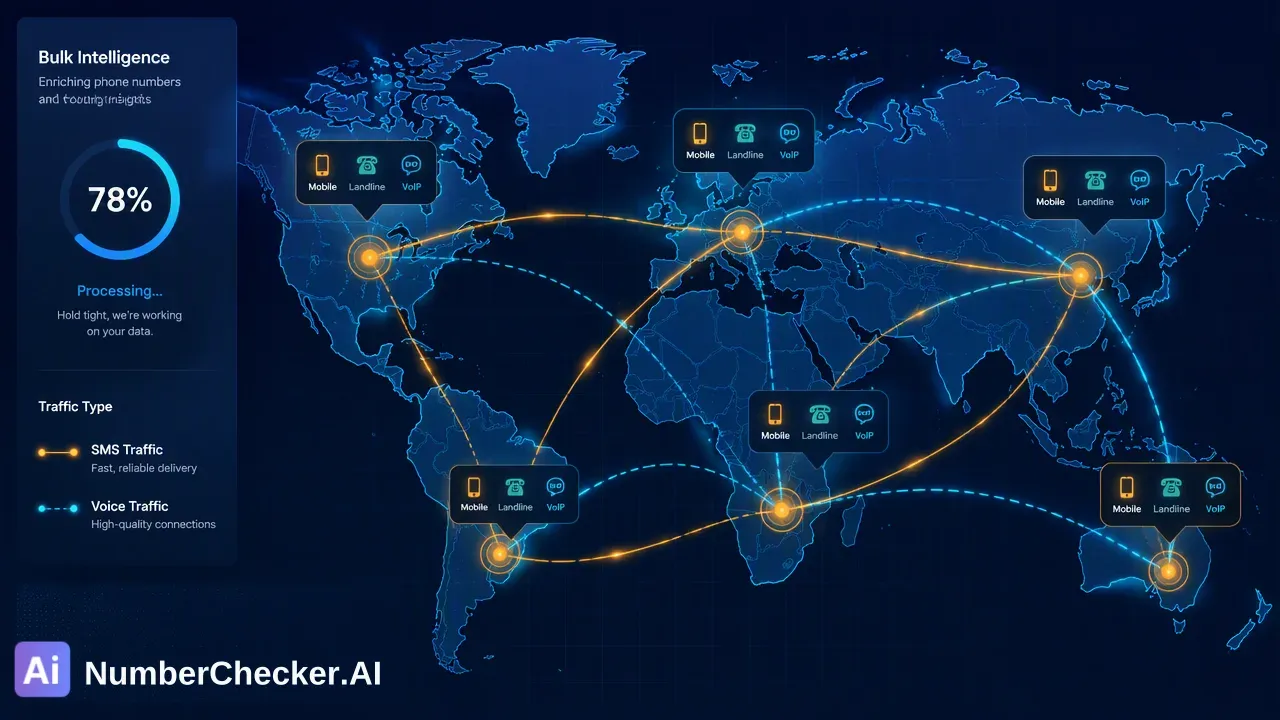
This carrier and line type data guide explains how these signals identify the service provider, classification (such as mobile, landline, or VoIP), and regional context of a phone number.
Understanding Carrier and Line-Type Data
Carrier intelligence is the process of identifying the service provider, line type, and regional context associated with a phone number. When organizations manage large contact databases, having visibility into the underlying infrastructure of each phone number helps teams review and segment their lists effectively. A line type is a classification that categorizes a phone number based on its underlying technology. The most common classifications include mobile, landline, and Voice over Internet Protocol (VoIP). Each of these technologies handles inbound communications differently. For example, a mobile line is typically capable of receiving both voice calls and Short Message Service (SMS) texts, whereas a traditional landline is generally restricted to voice communications. Carrier data also provides a location signal, identifying the country and regional context where the number is registered. This information contributes to contact intelligence by giving teams context for where a number originates and which telecommunications provider currently services it. The regional context goes beyond simple country identification; it helps organizations understand the specific geographic routing requirements associated with a number. This location signal is particularly valuable for businesses operating across multiple jurisdictions, as it supports compliance with regional communication preferences and time-zone considerations. By combining provider identification, line-type classification, and regional context, carrier intelligence delivers a comprehensive technical profile of a phone number.
Why Line-Type Classification Matters
Distinguishing between mobile, landline, and VoIP numbers informs routing decisions for SMS and voice communications. Organizations that rely on multi-channel outreach use line-type data to ensure they are attempting to reach contacts through technically supported methods. By identifying line types in advance, businesses can route SMS messages only to mobile-identified numbers. Conversely, voice calls can be routed to landlines, mobile devices, or VoIP lines depending on the organization’s communication strategy. Routing communications efficiently is not only a matter of technical compatibility but also of operational efficiency. Attempting to deliver SMS messages to incompatible landline numbers can result in unnecessary processing overhead and skewed campaign metrics. By filtering out landlines and unsupported VoIP numbers prior to an SMS campaign, organizations can focus their resources on viable mobile targets. Furthermore, understanding the line type can inform the timing and nature of voice outreach, as mobile devices and landlines often have different usage patterns. This classification also supports internal decisions regarding contact prioritization. For instance, a business might treat a VoIP number differently than a mobile number when evaluating risk or establishing communication workflows.
How Carrier Portability Impacts Contact Data
Number portability is a telecommunications mandate in many countries that allows individuals and businesses to retain their existing phone numbers when switching from one service provider to another. This capability fundamentally changes how organizations must approach contact data management. Historically, the prefix or area code of a phone number was sufficient to identify the issuing carrier and, by extension, the line type. However, because of portability, a number originally issued as a landline by a regional provider might be ported to a mobile carrier, or a mobile number might be ported to a VoIP service. Consequently, static prefix analysis is no longer a reliable method for determining line types or routing paths. Carrier intelligence addresses this challenge by identifying the current service provider and line type rather than the original issuer. By processing contact lists through bulk checking workflows, organizations can update their databases to reflect recent porting activity. This ensures that routing decisions are based on the current technical reality of the phone number, supporting more accurate segmentation and helping teams avoid routing errors caused by outdated carrier assumptions.
The Role of Bulk Processing in Contact Intelligence
Managing carrier and line-type data at scale requires efficient processing capabilities. For organizations handling extensive databases, checking numbers individually is impractical. NumberChecker.AI supports bulk checking of phone-number lists, allowing teams to process large volumes of contact data systematically. These bulk workflows support CSV or TXT list uploads, which are ideal for periodic database maintenance and list segmentation. When a business uploads a CSV or TXT file containing thousands of phone numbers, the bulk checking process evaluates each entry to append the relevant carrier and line-type signals. This enriched data can then be exported and integrated into customer relationship management (CRM) platforms or communication gateways. For teams requiring programmatic access, REST API integration allows for automated bulk processing within existing contact management systems. The REST API allows systems to submit batches of numbers programmatically, receiving the carrier intelligence needed to inform immediate routing decisions. By utilizing bulk processing, businesses can organize contact lists based on carrier and line-type signals before initiating communication campaigns. This workflow helps teams review their data comprehensively, applying routing rules across thousands of records simultaneously. The ability to process data in bulk is a core component of contact intelligence, transforming raw phone numbers into categorized lists that support targeted and technically appropriate outreach.
Global vs. Regional Carrier Intelligence
Different communication workflows require different scopes of carrier intelligence. NumberChecker.AI provides distinct tools to address both international and region-specific requirements, ensuring that organizations can access the appropriate level of detail for their target markets. The Global Carrier Checker is designed for international coverage. It identifies the carrier, line type, country, and regional context for phone numbers across supported countries worldwide. This tool is essential for multinational corporations, international shipping logistics, and global digital platforms that must route communications to users across diverse telecommunications networks. It standardizes the carrier and line-type data regardless of the country of origin, providing the location signals necessary to route communications across international borders. In contrast, the Advanced US Carrier Checker focuses specifically on North American infrastructure. It identifies the carrier, line type, and regional context exclusively for United States and Canada phone numbers. This tool is optimized for businesses whose primary audience resides in North America, providing the precise carrier intelligence and location signals required for regional routing workflows. By distinguishing between global and regional capabilities, organizations can select the tool that aligns with their operational footprint. Both tools operate on the principle of bulk processing, ensuring that regardless of the geographic scope, organizations can manage their contact intelligence efficiently.
Frequently Asked Questions (FAQ)
What is the difference between a mobile and a VoIP line type?
A mobile line type is associated with a physical cellular device and a wireless carrier, typically supporting both voice and SMS communications. A VoIP (Voice over Internet Protocol) line type routes calls over the internet rather than traditional cellular or copper-wire networks. While VoIP numbers can often receive voice calls and sometimes SMS, they are structurally different from mobile lines and are categorized differently for routing and risk assessment purposes.
How does carrier portability affect data accuracy?
Carrier portability allows consumers to keep their phone numbers when switching from one service provider to another. Because numbers frequently move between providers, static databases can quickly become outdated. Carrier intelligence tools check the current routing and provider information, helping teams review the most up-to-date service provider and line-type classification rather than relying on the original issuing carrier.
Get Started with NumberChecker.AI
Explore NumberChecker.AI’s supported bulk list-checking products and choose the capability that fits your workflow.
Ready to get started?
Try our WhatsApp number validation service and see the difference clean data makes.

